
Two-Year Outcomes in the PHARRLAP Rehabilitation Trial
Key Takeaways
- Two-year recovery trajectories were broadly similar between groups after repair for acute avulsion involving at least 2 tendons.
- Accelerated rehabilitation was associated with a better 3-month SF-12 physical score and lower hamstring pain severity at 3 and 12 months.
- Four reinjuries were reported across 24 months, with two in each group, and the investigators stated the trial was not powered to assess reinjury risk.
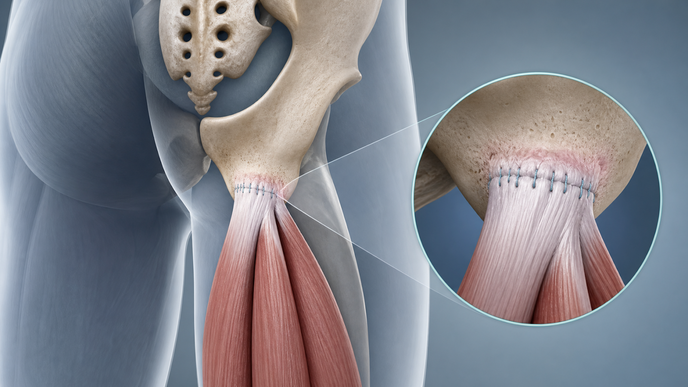
This prospective randomized controlled trial, identified as Level 1 evidence, enrolled patients undergoing repair after an acute traumatic avulsion involving at least 2 tendons. The conservative group included 30 patients and the accelerated group 27 in this proximal hamstring tendon repair trial. Eligibility also required a specific traumatic incident. Assessments occurred presurgery and at 3, 6, 12, and 24 months after surgery. Outcomes included patient-reported outcome measures, peak isokinetic knee flexor and extensor torque, single-leg horizontal hop distance, normalized outcomes, limb symmetry indices, complications, and reinjuries. The primary endpoint was the 6-month postoperative limb symmetry index for peak isokinetic knee flexor torque.
At 3 months, the accelerated group had a better 12-item Short-Form Health Survey physical score than the conservative group (P = .039). Hamstring pain severity was also lower with accelerated rehabilitation at 3 months (P = .034) and 12 months (P = .010). Normalized peak isokinetic knee flexor torque, peak isokinetic knee extensor torque, and single-leg horizontal hop distance each improved over time (all P < .001). Peak isokinetic knee flexor torque limb symmetry index and single-leg horizontal hop distance limb symmetry index also improved over time, each with P < .001. No between-group differences were observed for hop or strength outcomes, with P values above .05.
Over 24 months, four patients were reinjured, with two events in each group and an overall rerupture rate of 7%. The conservative group’s reinjuries occurred at 6 weeks and 3 months, whereas the accelerated group’s events occurred at 10 and 12 months. Complications and reinjuries were tracked throughout follow-up alongside functional recovery.
Overall, outcomes were broadly comparable across the two-year follow-up after acute proximal hamstring avulsion repair, although the investigators stated that the trial was not powered to assess differences in reinjury risk.