
Tumor Acidity Linked to PARP Resistance in Ovarian Cancer
Key Takeaways
- In ovarian cancer cells and preclinical ovarian cancer models, acidic conditions were associated with significantly lower sensitivity to PARP inhibitors.
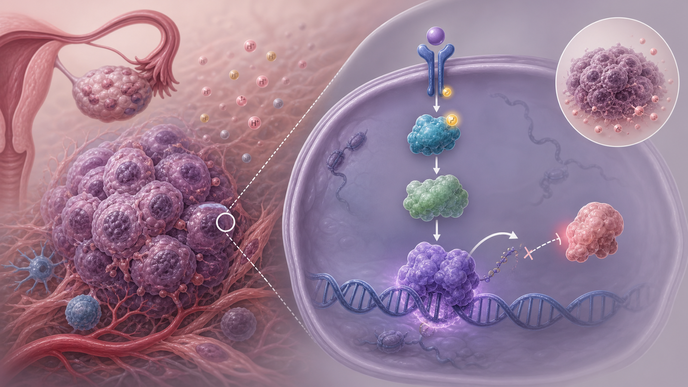
- The reported resistance mechanism linked acidity to ERK-p300-PARP1 signaling, PARP1 acetylation, and reduced PARP trapping.
- Both genetic and pharmacologic p300 inhibition restored PARP inhibitor sensitivity and enhanced antitumor activity across multiple preclinical ovarian cancer models, including acquired-resistance models.
- In tumor samples from patients treated with PARP inhibitors, higher activated ERK and acetylated PARP1 were associated with resistance and poorer outcomes.
Investigators studied preclinical ovarian cancer models and paired that work with tumor-sample analysis from patients who had been treated with PARP inhibitors. The mechanistic experiments focused on extracellular signal-regulated kinase (ERK), p300, and PARP1, and a large-scale clustered regularly interspaced short palindromic repeats (CRISPR) genetic screen was used to look for drivers of the acidity-linked resistance program.
Ovarian cancer cells exposed to acidic conditions became significantly less sensitive to PARP inhibitors, even though treatment delivery to the cancer cells was described as unchanged. Investigators linked that resistance signal to an ERK-p300-PARP1 network in which PARP1 acetylation reduced PARP trapping, pointing to a biologic adaptation rather than a drug-access problem. The CRISPR screen identified p300 as a critical driver of the pathway, and both genetic and pharmacologic p300 inhibition restored PARP inhibitor sensitivity and enhanced antitumor effects across multiple preclinical models, including models with acquired resistance.
The evidence described here remains preclinical, so the report does not establish patient benefit from combining p300 inhibitors with PARP inhibitors in ovarian cancer. Tumor samples from patients treated with PARP inhibitors showed that higher activated ERK and acetylated PARP1 were associated with resistance and poorer outcomes, but those observations remain associative rather than proof of predictive clinical utility.
Acidic tumor signaling emerged in Cancer Research as a reported driver of acquired PARP inhibitor resistance through ERK-p300-PARP1 signaling, with p300 identified as the central intervention point from the CRISPR screen and inhibition experiments. The investigators highlighted combined p300 and PARP inhibition and evaluation of ERK activation or PARP1 acetylation as candidate resistance biomarkers for further study. The findings leave acidity-linked signaling, rather than impaired treatment delivery, as the mechanism that warrants additional investigation in ovarian cancer.
Clinician Questions
Which settings does the reported p300-PARP inhibitor resistance signal in ovarian cancer actually apply to?
The reported signal applies to ovarian cancer cells under acidic conditions, multiple preclinical ovarian cancer models including acquired-resistance models, and a tumor-sample analysis from patients already treated with PARP inhibitors. The restorative effect of p300 inhibition was shown only in preclinical systems, whereas the patient material supports biomarker correlation rather than evidence that the combination improves outcomes.
How did the investigators link tumor acidity to reduced PARP inhibitor activity in ovarian cancer?
The investigators placed the mechanism downstream of acidity rather than drug delivery, because treatment exposure to cancer cells was described as unchanged. Within that setting, acidic conditions were linked to ERK, p300, and PARP1 activation, and p300-mediated PARP1 acetylation was reported to reduce PARP trapping.
What did the tumor-sample findings show about ERK activation and PARP1 acetylation in ovarian cancer treated with PARP inhibitors?
The tumor-sample analysis supports these markers as candidate indicators of a resistant biology, because higher activated ERK and acetylated PARP1 tracked with resistance and poorer outcomes. The available report does not show that either marker has been validated for patient selection, response prediction, or treatment monitoring.