
TRIC-I-HF: Tricuspid Repair Cut HF Events in Severe TR
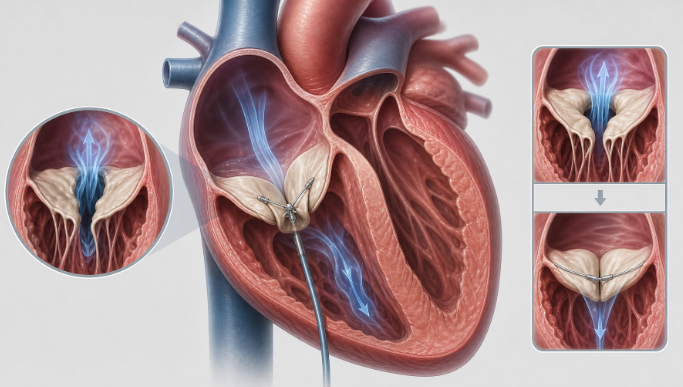
Key Takeaways
- Patients with symptomatic severe tricuspid regurgitation and increased risk of future heart-failure events had better outcomes with transcatheter tricuspid-valve repair plus medical therapy than with medical therapy alone on the 1-year hierarchical primary endpoint.
- Freedom from death from any cause or hospitalization for heart failure through 3 years was 52.4% with repair plus medical therapy and 21% with medical therapy alone.
- Repair plus medical therapy was associated with a statistically significant lower risk of the 3-year composite of death from any cause or hospitalization for heart failure.
- Major adverse events within 30 days occurred in 5.9% of patients assigned to tricuspid-valve repair.
In TRIC-I-HF in the New England Journal of Medicine, investigators randomly assigned 360 patients in a 2:1 ratio to repair plus medical therapy or medical therapy alone, with 237 and 123 patients in the two groups, respectively. The mean age was 80.3 years, and 56.4% were women. The first primary endpoint was a hierarchical composite of death from any cause, hospitalization for heart failure, and quality-of-life improvement at 1 year assessed by win ratio. If that comparison was significant, a second primary endpoint was to be tested as the composite of death from any cause or hospitalization for heart failure through 3 years.
At 1 year, the hierarchical primary endpoint favored repair plus medical therapy, with a win ratio of 2.42 (95% confidence interval, 1.76 to 3.33; P<0.001). This result reflects the trial's ordered assessment of survival, heart-failure hospitalization, and quality-of-life improvement rather than an isolated hard-outcome measure.
For the 3-year composite outcome in TRIC-I-HF, Kaplan-Meier estimates for freedom from death from any cause or hospitalization for heart failure were 52.4% (95% confidence interval, 43.2 to 63.6) with repair plus medical therapy and 21% (95% confidence interval, 12.7 to 34.6) with medical therapy alone, corresponding to a hazard ratio of 0.40 (95% confidence interval, 0.29 to 0.55; P<0.001). Major adverse events within 30 days occurred in 14 patients (5.9%) in the tricuspid-repair group. The abstract did not separate the 3-year composite into individual death and hospitalization results.
The reported benefit applies to patients with symptomatic severe tricuspid regurgitation and increased risk of future heart-failure events as defined in TRIC-I-HF. Because the 1-year primary outcome was hierarchical and included quality-of-life improvement, it should not be described as a pure mortality or hospitalization endpoint. The 3-year finding was reported as a composite of death from any cause or hospitalization for heart failure.
According to the authors, transcatheter tricuspid-valve repair plus medical therapy was superior to medical therapy alone on the 1-year hierarchical composite endpoint and was associated with a lower risk of the 3-year composite of death from any cause or hospitalization for heart failure. These findings add longer-term clinical outcome data to the symptomatic context in which this high-risk population is being considered for transcatheter intervention.
Clinician Questions
Which patients were included in TRIC-I-HF?
TRIC-I-HF enrolled patients with symptomatic severe tricuspid regurgitation and an increased risk of future heart-failure events. The randomized cohort had a mean age of 80.3 years, and 56.4% were women, so the findings apply most directly to an older, high-risk population rather than to all patients with tricuspid regurgitation.
What did the 1-year primary endpoint include in TRIC-I-HF?
The first primary endpoint was a hierarchical composite of death from any cause, hospitalization for heart failure, and quality-of-life improvement at 1 year, assessed by win ratio. That structure means the 1-year result should not be interpreted as a stand-alone mortality or hospitalization outcome.
Was the 3-year outcome in TRIC-I-HF reported separately for death and heart-failure hospitalization?
No. The article reports the 3-year result only as a composite of death from any cause or hospitalization for heart failure, and separate event rates for the individual components were not provided.