
Traffic-Light Menu Labels And Fast-Food Ordering Behavior
Key Takeaways
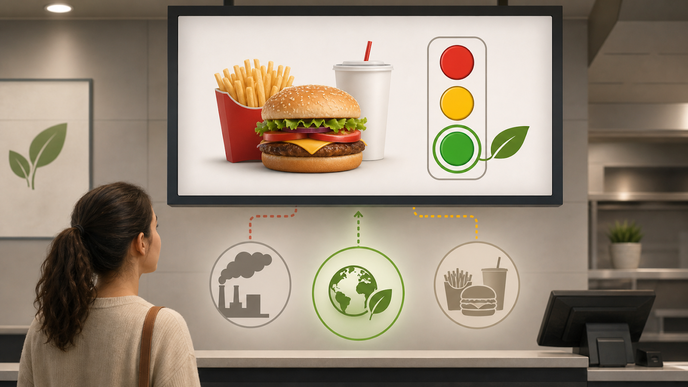
- Traffic-light labels were associated with a higher modified Nutrient Profile Index score in the burger restaurant, while no ecolabel changed that score in the sandwich restaurant.
- Traffic-light labels were associated with lower greenhouse gas emissions and greater selection of sustainable items in both restaurants, plus lower red-meat selection in the burger restaurant.
- Traffic-light labels were most noticeable and best understood, while meal cost and sugar-sweetened beverage selection did not differ by condition, and no significant interactions between label condition and sociodemographic characteristics were seen for Nutrient Profile Index scores.
The investigation was conducted online from April 1 to April 23, 2025, and was published July 10, 2026, using the NORC AmeriSpeak probability-based, nationally representative US panel. Adults aged 18 years or older comprised the final analytic sample of 6210 participants, with a mean age of 48.1 years and 51.0% women. Randomization assigned 1236 participants to control QR code, 1249 to low-climate-impact, 1235 to traffic-light, 1243 to high-climate-impact, and 1247 to grade-scale labels. Participants ordered lunch from burger-focused and sandwich-focused menus; the primary outcome was the mean modified Nutrient Profile Index score, and the target sample size was 6000. Beverages were excluded from meal-level NPI and greenhouse gas calculations, and the design compared these formats across two restaurant types against control.
In the burger restaurant, traffic-light labels were associated with a higher mean modified NPI score than control, 49.93 (SE 0.18) versus 49.25 (SE 0.18), P<.001. No ecolabel changed NPI score in the sandwich restaurant. Traffic-light labels were also associated with 15.2% lower emissions for selected meals in the burger restaurant, 17.9 (0.7) versus 21.1 (0.7) kgCO2e, P=.001. In the sandwich restaurant, emissions for selected meals were 29.8% lower, at 13.6 (0.8) versus 19.4 (1.0) kgCO2e, P<.001. Traffic-light labels also had lower emissions than low-impact and high-impact labels, increased sustainable-item selection in both restaurants, and lowered red-meat selection in the burger restaurant.
Traffic-light labels were the most noticeable at 78.30% (95% CI, 75.35%-81.26%) versus 42.85% (95% CI, 39.23%-46.48%) in control, and correct understanding reached 88.72% (95% CI, 86.04%-91.39%). Less than half of participants reported using ecolabels, with the highest use in the traffic-light group at 38.9% (95% CI, 34.5%-43.2%). All ecolabel conditions improved identification of higher-climate-impact items, with the highest correct response in the traffic-light group at 66.07% (95% CI, 62.64%-69.50%). Traffic-light and grade-scale labels improved climate-impact ranking, ecolabels were less believable than control, and meal cost and sugar-sweetened beverage selection did not differ by condition. There were also no significant interactions between label condition and sociodemographic characteristics for NPI scores. The authors noted that the task was hypothetical and one-time, with no spending or consumption, and cited possible social desirability and scope limits for NPI and greenhouse gas estimates.