
TOP2A-E2F6-DKK1 Axis Links EMT to HCC Prognosis
Key Takeaways
- Across public HCC cohorts and a clinical tissue-validation cohort, TOP2A upregulation aligned with poorer disease features and shorter survival, while preclinical models supported a role in aggressive tumor behavior.
- In the clinical IHC cohort, the TOP2A score remained independently associated with overall survival, and a nomogram combining the TOP2A IHC score, TNM stage, and tumor grade showed consistent survival discrimination.
- E2F6 tracked positively with TOP2A across cohorts, and functional assays supported E2F6 as a direct transcriptional regulator of TOP2A.
- A dual-high E2F6/TOP2A subgroup was associated with poorer survival and retained strong discrimination across external validation cohorts.
- Exploratory response analyses associated high TOP2A expression with less favorable TACE, sorafenib, and immunotherapy-response patterns, while A-443654 alone or with anti-PD-L1 suppressed tumor growth in vivo.
Investigators integrated public transcriptomic cohorts, a surgical tissue-validation series, and laboratory models in a Frontiers in Immunology study of the E2F6-TOP2A-DKK1 axis in hepatocellular carcinoma. The analysis included The Cancer Genome Atlas liver hepatocellular carcinoma cohort (TCGA-LIHC), where 371 tumor tissues and 50 non-tumor tissues informed differential-expression analyses and 337 patients informed survival analyses; the International Cancer Genome Consortium hepatocellular carcinoma cohort (ICGC-HCC/LIRI-JP) with 231 patients; Gene Expression Omnibus datasets GSE109211 and GSE104580; a 120-specimen surgical immunohistochemistry cohort with follow-up through May 20, 2025; stable knockdown experiments in Huh7, HepG2, and HCCLM3 cells; chromatin immunoprecipitation quantitative polymerase chain reaction (ChIP-qPCR); and mouse xenografts. Exploratory treatment-response analyses also used transcatheter arterial chemoembolization (TACE) and sorafenib responder cohorts, including 81 responders and 66 non-responders for TACE and 21 responders and 46 non-responders for sorafenib, while Tumor Immune Dysfunction and Exclusion (TIDE) plus pRRophetic were used to probe immunotherapy responsiveness and candidate drug sensitivity.
TOP2A was upregulated in HCC and separated tumor from non-tumor tissue in TCGA-LIHC with an AUC of 0.935, increased with stage, and was associated with shorter overall survival. In the clinical immunohistochemistry cohort, the TOP2A immunohistochemistry (IHC) score remained associated with overall survival after adjustment for age, tumor grade, pathologic tumor-node-metastasis (pTNM) stage, and alpha-fetoprotein, with HR 1.014 and 95% CI 1.007-1.020. A nomogram built from the TOP2A IHC score, tumor-node-metastasis (TNM) stage, and tumor grade yielded a C-index of 0.76 and 1-, 3-, and 5-year overall survival AUCs of 0.77, 0.85, and 0.75.
E2F6 paralleled TOP2A across cohorts, with R 0.73 in TCGA-LIHC and R 0.66 in ICGC-HCC; E2F6 knockdown reduced TOP2A messenger RNA and protein expression, TOP2A knockdown did not significantly change E2F6 messenger RNA, and ChIP-qPCR supported direct promoter binding. A concurrent high-expression E2F6/TOP2A subgroup had poorer survival, and a logistic model using PredictScore = 6.8719 × E2F6 + 2.3388 × TOP2A identified that subtype with E2F6 OR 6.87 (95% CI 4.84-9.49) and TOP2A OR 2.34 (95% CI 1.68-3.18), an AUC of 0.989 in TCGA-LIHC, and validation AUCs of 0.985, 0.810, and 0.937 across ICGC-HCC, GSE109211, and GSE104580. Downstream analyses identified 597 differentially expressed genes in the dual-high comparison and 47 downregulated plus 186 upregulated genes in TOP2A-high versus TOP2A-low tumors, with enrichment spanning inflammatory response, interleukin-6-Janus kinase-signal transducer and activator of transcription 3, EMT, and WNT-β-catenin signaling and with DKK1 highlighted as a key mediator.
Treatment-response signals remained exploratory: TACE and sorafenib findings were response associations from existing Gene Expression Omnibus cohorts, immunotherapy responsiveness was inferred through TIDE rather than observed in a prospective immune-checkpoint cohort, and pRRophetic was used as a discovery screen with inherent limits for predicting in vivo response. Within that source-bounded frame, high TOP2A expression was associated with poorer TACE, sorafenib, and immunotherapy-response patterns, while A-443654 alone or with anti-programmed death-ligand 1 (anti-PD-L1) suppressed tumor growth in vivo.
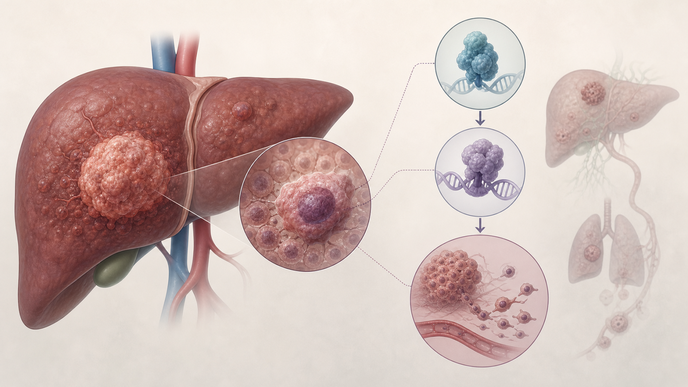
The authors positioned the E2F6-TOP2A-DKK1 axis as a mechanistic link between EMT biology, biomarker performance, and candidate targeting signals in HCC.
Clinician Questions
What evidence linked E2F6 to direct regulation of TOP2A in hepatocellular carcinoma?
In hepatocellular carcinoma, E2F6 expression correlated positively with TOP2A in TCGA-LIHC and ICGC-HCC, E2F6 knockdown reduced TOP2A mRNA and protein expression, TOP2A knockdown did not significantly change E2F6 mRNA levels, and ChIP-qPCR supported direct binding of E2F6 to the TOP2A promoter.
How was the dual-high E2F6/TOP2A subtype identified and validated in hepatocellular carcinoma?
Investigators defined a concurrent high-expression E2F6/TOP2A subgroup in hepatocellular carcinoma, found poorer survival in that group, and built a logistic model using both markers with a PredictScore of 6.8719 × E2F6 + 2.3388 × TOP2A; discrimination was AUC 0.989 in TCGA-LIHC and validated with AUCs of 0.985, 0.810, and 0.937 in ICGC-HCC, GSE109211, and GSE104580.
What downstream biology connected TOP2A to epithelial-mesenchymal transition in hepatocellular carcinoma?
In hepatocellular carcinoma, TOP2A-high versus TOP2A-low analyses identified 47 consistently downregulated and 186 consistently upregulated genes, enrichment involved inflammatory response, IL-6-JAK-STAT3, epithelial-mesenchymal transition, and WNT-β-catenin signaling, and DKK1 was identified as a key downstream mediator of TOP2A-regulated epithelial-mesenchymal transition.
What treatment-response signals were associated with high TOP2A expression in hepatocellular carcinoma?
High TOP2A expression in hepatocellular carcinoma was associated with poorer response patterns for TACE and sorafenib in existing GEO cohorts and with less favorable immunotherapy responsiveness on TIDE-based analysis, while A-443654 alone or with anti-PD-L1 suppressed tumor growth in vivo; the authors presented these as retrospective associations, computational predictions, and preclinical findings rather than patient trial evidence.