
Text Messaging for Cardiovascular Risk Prevention in Psoriasis
Key Takeaways
- The 6-month SMS program was associated with higher patient activation than usual care in adults with psoriasis.
- Mediterranean diet adherence, medication adherence, psoriasis-CVD knowledge, and physical activity improved, and BMI decreased, with the text-messaging intervention.
- Lipid parameters, hemoglobin A1c, smoking behavior, dermatology-specific quality of life, and psoriasis severity did not differ significantly between groups.
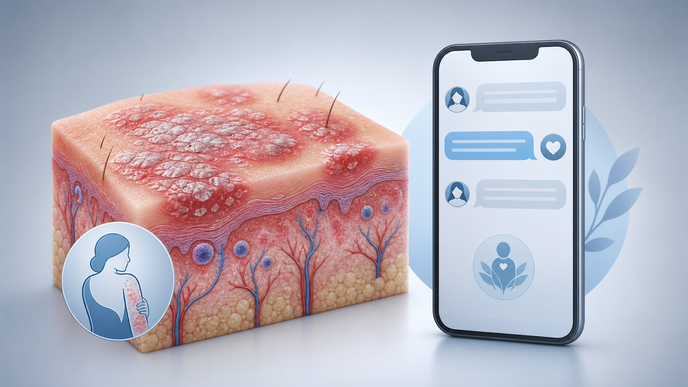
This single-center, parallel-group randomized clinical trial was conducted in an Australian tertiary hospital dermatology clinic and reflected outpatient specialty care. Adults with dermatologist-confirmed psoriasis were randomized 1:1 during outpatient visits between April and July 2024; 111 participants entered, with a mean age of 51.8 years and 65.1% male. TEXTME PSO, or Tobacco, Exercise, and Diet Messages for Psoriasis, delivered 4 text messages weekly for 6 months to the intervention group, while the comparator was standard care. The primary outcome was the 13-item Patient Activation Measure, and secondary outcomes covered behavioral, cardiometabolic, dermatology, and user-feedback domains.
At 6 months, patient activation favored the intervention, with an adjusted mean difference of 10.8 points, a 95% CI of 7.0 to 14.6, and P<.001. Mediterranean diet adherence improved by 1.7 and medication adherence by 1.6, with respective 95% CIs of 1.0-2.4 and 0.8-2.5; both P<.001. Psoriasis-CVD knowledge improved by 6.6 and physical activity by 127.9 minutes weekly, with respective 95% CIs of 4.7-8.4 and 21.9-234.0; P<.001 and P=.02. In covariance-adjusted intention-to-treat analyses with multiple imputation, BMI decreased by 1.0, with a 95% CI of -1.4 to -0.7 and P<.001. The changes were concentrated in activation and behavior-linked measures.
No statistically significant between-group differences appeared for lipid parameters, hemoglobin A1c, smoking behavior, dermatology-specific quality of life, or psoriasis severity. That included laboratory measures as well as the Dermatology Life Quality Index and Psoriasis Area and Severity Index. User feedback was also listed among secondary outcomes. Over 6 months, the intervention was associated with changes in activation and several behavior-linked measures, without corresponding differences in lipid, glycemic, or psoriasis outcomes.