
TDF–FTC Vaginal Ring Meets Drug Exposure Targets in Phase 1 Trial
Key Takeaways
- Among healthy HIV-negative premenopausal women in Galveston, related AE counts did not differ significantly between active TDF–FTC and placebo rings.
- Vaginal tissue TFV-DP and FTC-TP exceeded investigators’ targets during active-ring use, while plasma exposure was low.
- Active-ring use produced no reproducible change in the vaginal microbiome.
- Rectal fluid TFV and FTC were measurable at substantially lower concentrations than in CVF, while rectal tissue concentrations were generally below quantification.
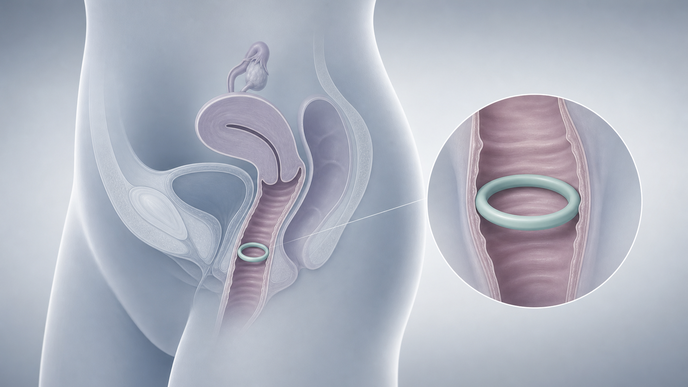
In Vincent and colleagues’ TDF–FTC intravaginal ring trial, investigators conducted a Phase 1, double-blind, placebo-controlled, randomized-order crossover at the University of Texas Medical Branch in Galveston. Participants were healthy, HIV-seronegative premenopausal adults at low risk for sexually transmitted infections. Enrollees who withdrew before randomized ring use were excluded; 10 women completed both 28-day ring periods, divided equally between the two treatment sequences. A no-ring baseline preceded active and placebo ring use, with a washout between periods. Assessments included related adverse events (AEs), colposcopy, vaginal histology, optical coherence tomography of vaginal, forniceal, and cervical epithelium, vaginal microbiome composition, and drug measurements in cervicovaginal fluid (CVF), vaginal and rectal tissue, rectal fluid, and plasma. HIV acquisition was not an efficacy endpoint.
Investigators recorded 19 ring-related AEs, without a statistically significant difference in related-event counts between active and placebo use. Events were mild or moderate; there were no serious AEs or severe genitourinary AEs. Colposcopy found no ring-related findings. Histology and epithelial-thickness comparisons showed no significant differences, and vaginal microbiome composition showed no reproducible shift. During active-ring use, CVF contained measurable tenofovir (TFV) and FTC.
In vaginal tissue during active-ring use, median tenofovir diphosphate (TFV-DP) reached 0.651×10³ fmol/mg and emtricitabine triphosphate (FTC-TP) reached 0.180×10³ fmol/mg. Investigators assessed both concentrations as exceeding their defined targets. Plasma TFV and FTC concentrations were low. Rectal tissue drug concentrations were generally below quantification, although both drugs were measurable in rectal fluid at concentrations lower than in CVF.
The investigators cautioned that the limited number of completers and related events left treatment and period comparisons imprecise. The nonsignificant difference in related-event counts neither establishes equivalent safety nor rules out clinically meaningful effects. Participants were healthy and at low risk for sexually transmitted infections, and active-ring exposure was brief; findings may not extend to higher-risk populations or longer use. Exposure benchmarks associated with protection were pharmacokinetic measures, not evidence of reduced HIV acquisition.
Vincent and colleagues interpreted the TDF–FTC pod ring as generally well tolerated during the studied use period and as achieving their vaginal pharmacokinetic benchmarks. Those observations do not establish whether the ring prevents HIV acquisition.
Clinician Questions
Why was the no-ring baseline not a third randomized comparison for the TDF–FTC vaginal ring?
The no-ring baseline occurred earlier, was not randomized, and lacked a ring. Investigators therefore used the randomized active-versus-placebo crossover for the treatment comparison.
Were tenofovir and emtricitabine detectable in vaginal swabs during placebo-ring use?
All vaginal-swab drug measurements during placebo-ring periods in the TDF–FTC pod-ring trial were below the analytical limit of quantification. This placebo measurement did not assess HIV prevention.