
Tattoo-Associated NTM Skin Infections Often Trace to Contaminated Ink
Key Takeaways
- Reported outbreaks were a notable feature of published tattoo- and permanent makeup–associated NTM skin infections from 2003 to 2024 and accounted for most affected individuals described, although they represented about one-third of reported case events.
- Rapidly growing mycobacteria predominated, especially Mycobacterium chelonae and M. abscessus.
- Symptoms usually began within weeks after tattooing or PMU, and delayed or incorrect initial diagnosis was common.
- Contaminated ink was the leading identified source of reported tattoo- and PMU-associated NTM skin infections.
- Macrolide-based combination antibiotics were reported most often, and recovery commonly extended over several months.
Published tattoo- and PMU-associated NTM skin infections spanning 2003 to 2024 were compiled in the Daddy-Gaoh et al review of tattoo-associated nontuberculous mycobacterial skin infections through Medline and Google Scholar searches without language restrictions, with manual review of reference lists and citing articles. Eligible material included case reports, outbreak reports, government health department reports, case reviews, conference presentations, and surveys when case-level details were available. The authors defined a case as an infectious event that could involve one person or many people in the same period or geographic area when it was linked to a common source such as a particular ink, tattoo parlor, or tattooist, so reported case totals describe infectious events rather than affected individuals.
Outbreak clustering defined much of the epidemiology, with 25 outbreaks affecting 262 of 311 individuals and accounting for more than 80% of affected individuals. Among cases with an identified source, contaminated ink accounted for 30 of 37 cases (81%); nonsterile dilution during procedures was responsible for 22 cases involving 127 individuals, and manufacturing contamination for 8 cases involving 120 individuals. Clustering around contaminated ink therefore emerged as the dominant epidemiologic pattern.
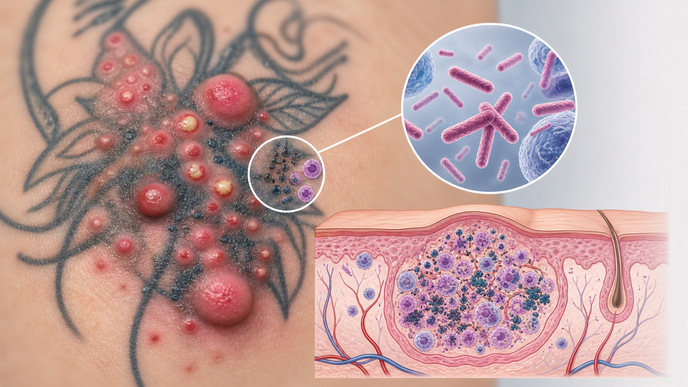
Rapidly growing mycobacteria predominated, with M. chelonae identified in 32 cases and M. abscessus in 12 cases. Symptoms began within the first week in 17 cases and within 1 to 4 weeks in 33 cases, while 45 cases, about 70%, were misdiagnosed or initially undiagnosed. Chronic papules, pustules, and nodules were the most common lesions, granulomatous inflammation was the prevailing histologic pattern, and culture-based plus molecular methods were the main confirmation approaches, including 54 culture-based identifications and 20 molecular identifications. Macrolide-based regimens were reported most often, with combination therapy used in 40 cases versus 17 cases treated with a single antibiotic, and among 47 cases with recovery data, 24 resolved in 3 to 6 months.
According to the authors, tattoo- and PMU-associated NTM infection emerges as an outbreak-prone pattern centered on contaminated ink, nonspecific chronic lesions, delayed recognition, and prolonged macrolide-based combination treatment.
Clinician Questions
How did the review define a case in tattoo-associated NTM skin infections?
A case in tattoo-associated NTM skin infections was defined as an infectious event occurring in the same period or geographic area and linked to a common source such as a specific tattoo ink, tattoo parlor, or tattooist. One outbreak affecting multiple people could count as one case, so case totals and individual totals are not interchangeable in tattoo-associated NTM skin infections.
What does a negative AFB stain mean in tattoo-associated NTM skin infection?
In the reviewed tattoo-associated NTM cases, acid-fast bacilli (AFB) were detected in 22 of 67 cases, but among 43 cases in which AFB staining was attempted, 21 were negative. A negative AFB stain did not exclude tattoo-associated NTM infection in these reports, and culture-based plus molecular methods were the main confirmation approaches.
How often were permanent makeup cases reported in tattoo-associated NTM infections?
4 of the 5 PMU cases were linked to ink contamination and 2 were attributed to manufacturer-level contamination.