
Tablet-Based Augmented Reality During Pediatric Venipuncture
Key Takeaways
- Both augmented reality groups were associated with lower anxiety and fear than usual care during venipuncture.
- Post-procedural pain scores were lower in the augmented reality groups across child-, parent-, and nurse-reported assessments.
- The authors described tablet-based augmented reality as a feasible nonpharmacologic support approach that could fit routine pediatric nursing workflows.
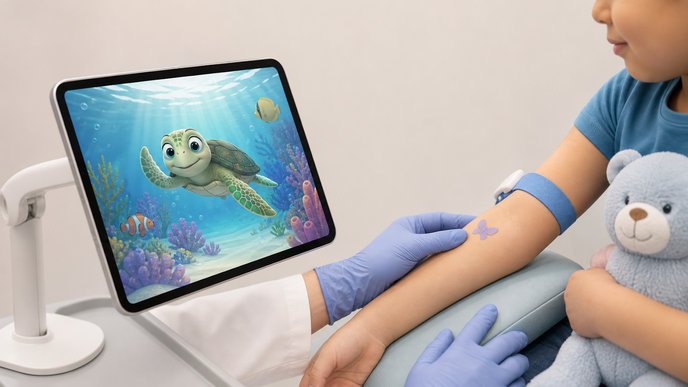
In a randomized trial in a university hospital pediatric blood draw unit, 120 children ages 5 to 12 were assigned to two tablet-based augmented reality groups or usual care during venipuncture. The three-arm comparison included AR Group A, AR Group B, and a control group. Both tablet-based applications were associated with lower procedural distress than usual care, including lower anxiety and fear during venipuncture.
This prospective, three-arm, parallel randomized controlled trial was conducted in the pediatric blood draw unit of a university hospital. Children aged 5 to 12 years were randomized to AR Group A, AR Group B, or usual care, with 120 children included in the final analysis. Each group contributed 40 participants, and baseline characteristics were comparable across groups. Two different tablet-based augmented reality applications were delivered during venipuncture, and the trial compared distress-related endpoints across the three groups.
Anxiety and fear were assessed before and after venipuncture with the Children’s Anxiety Meter–State and Child Fear Scale, respectively, while post-procedural pain was measured using the Wong–Baker Faces Pain Rating Scale. Outcomes were reported by children, parents, and nurses, and repeated measures ANOVA and Welch ANOVA were used for analyses. Both augmented reality groups showed significant reductions in anxiety and fear versus control, with significant time, group, and time × group effects for both outcomes. Post-procedural pain scores were also significantly lower in the augmented reality groups than in control across child-, parent-, and nurse-reported assessments. Across the reported measures, distress outcomes consistently favored the tablet-based interventions.
The authors concluded that tablet-based augmented reality reduced anxiety, fear, and pain during pediatric venipuncture. They also stated that these tablet applications could be integrated into routine pediatric nursing care without disrupting standard workflows. Publication was listed as 06 July 2026.