
Supported Running Study Finds Faster Repeat Neural Adaptation
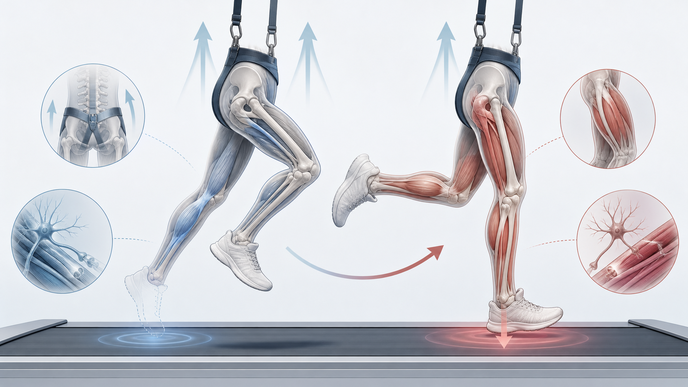
Key Takeaways
- Lower-body positive pressure treadmill running in healthy young men left some neural adjustments incomplete at the end of the first unweighting transition.
- Several unweighting adjustments were completed sooner during the second exposure, a pattern the authors interpreted as savings.
- Reloading back to full body weight was associated with completion of neural adjustments by the end of the transition in both runs.
- A transient stabilization synergy appeared only early in first-exposure unweighting, alongside coordination-level timing shifts that differed between unweighting and reloading.
In the study, 38 physically active male students with no prior unweighted-running experience completed two 9-minute runs separated by 4 minutes of recovery, with stable phases at 100%, 60%, and 100% body weight. Each transition lasted 12 ± 2 seconds and included 16 ± 4 running cycles. Investigators recorded vertical force plus surface electromyography (EMG) from 11 right lower-limb muscles and analyzed root mean square EMG and muscle synergies cycle by cycle. Transitions were standardized into eight intervals, and early stable phases included the first 150 cycles, so adjustment could be followed stride by stride.
Force measures declined during unweighting and rose again during reloading, but the first transition into support was not fully settled by its end. In RUN1, some unweighting adjustments remained incomplete, especially hamstring preactivation and triceps surae braking and push-off activity, whereas several analogous changes were finished earlier in RUN2 in the cycle-by-cycle neural adjustment analysis. As one representative example, gastrocnemius medialis braking was completed at UNWbeg C84 in RUN1 versus UNWtr C̄3 in RUN2. The loading index was higher at UNWend in RUN1 than RUN2 (p < 0.001; ES = 0.36). Reloading reversed the unweighting pattern, and the authors report that neural adjustments were complete by the end of reloading in both runs.
Four muscle synergies were consistent across runs, while a fifth stabilization synergy appeared only at UNWtr C̄1 and C̄2 in RUN1 and was described by the authors as a fractionation of the braking synergy. The timing of stance-related synergies shifted later during unweighting and earlier during reloading, with overshoot in RUN1 that was not seen in RUN2. During unweighting, electromyography-force correlations were mainly positive for quadriceps braking activity and negative for hamstrings during braking and push-off.
These findings came from a short-term experimental physiology protocol in healthy, physically active young men who had never run under reduced body-weight support before, so they do not directly test injured, postoperative, or return-to-run populations. The authors interpreted first unweighting as a novel sensorimotor context in which decreasing mechanical constraints interacted with increasing sensory and temporal constraints, whereas reloading restored a more familiar context. In sports medicine and rehabilitation settings, lower-body positive pressure treadmills are used clinically, but this report addresses adaptation dynamics rather than patient outcomes.
The authors concluded that first unweighting and reloading were not simple mirror-image processes at the neural level. They also interpreted the faster response during the second unweighting exposure as evidence of savings within this treadmill paradigm.
Clinician Questions
Which runners were represented in the lower-body positive pressure treadmill transition experiment?
The experiment enrolled healthy, physically active young men with a mean age of 19 ± 1 years who had been free of musculoskeletal injury and sensory disorder for at least 1 year. None had prior experience with unweighted running, so the findings describe first and repeated exposure in that population rather than injured or postoperative runners.
How were adaptation changes tracked during unweighting and reloading on the lower-body positive pressure treadmill?
Investigators analyzed each running cycle separately using vertical force, phase-specific root mean square electromyography from 11 right lower-limb muscles, and muscle-synergy measures. Transitions were standardized into eight intervals, and the first 150 cycles after each transition were also analyzed, so adaptation was followed stride by stride rather than only at steady state.
What did the authors mean by savings during repeat exposure to supported running?
The authors used savings to describe the earlier completion of several neural adjustments during the second unweighting run, compared with the first, along with disappearance of some first-run overshoot or undershoot patterns. They presented that interpretation as a feature of repeat exposure within this supported-running protocol rather than as a broader training claim.
Why was a completion point not identified for some reloading adjustments?
For some reloading measures, activity was already not significantly different from the final reloaded state at the first analyzed reloading interval, so there was no later cycle at which completion could be newly assigned. In this protocol, that reflects how completion was defined analytically rather than inconsistent physiology.