
Sirolimus-Eluting Balloon Strategy Versus Routine DES in De Novo Lesions
Key Takeaways
- At 1 year, target vessel failure was reported in 5.3% of patients with the sirolimus-eluting balloon strategy and 4.4% with systematic DES implantation, and noninferiority was met in the intention-to-treat analysis.
- Bailout stenting was required in 20.7% of patients assigned to the balloon strategy, and clinically driven target vessel revascularization was more frequent in that group.
- Safety events, including lesion thrombosis, were low and similar in both groups, while the prespecified per-protocol sensitivity analysis did not confirm noninferiority.
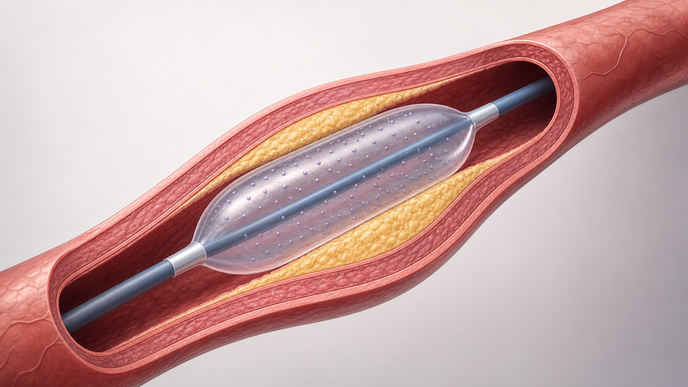
Investigators randomized 3,323 participants 1:1 before PCI at 62 sites between August 27, 2021, and July 29, 2024. The intervention was a sirolimus-eluting balloon strategy with provisional DES, and the comparator was systematic DES implantation. The primary endpoint was target vessel failure, combining cardiac death, target vessel-related myocardial infarction, and clinically driven target vessel revascularization. Noninferiority was assessed at 365 days in the intention-to-treat population with a 2.44% absolute margin, equal to 50% of the combined event rate, at 0.025 significance. The comparison centered on a prespecified 1-year composite efficacy outcome.
At 365 days, target vessel failure occurred in 88 of 1,661 patients, or 5.3%, with the balloon strategy and 73 of 1,662, or 4.4%, with systematic DES. The risk difference was 0.91%, with a 95% CI from -0.55% to 2.38%, and the one-sided P value for noninferiority was 0.02. Clinically driven target vessel revascularization occurred more often with the balloon strategy, at 3.3% versus 2.1%, for a risk difference of 1.22%. The 95% CI for that difference ranged from 0.11% to 2.33%, leaving a noninferior primary result alongside more repeat target-vessel revascularization.
Bailout stenting was required in 343 of 1,661 patients assigned to the sirolimus-eluting balloon strategy, a rate of 20.7%. Safety events, including lesion thrombosis, were low and similar in both groups. A prespecified per-protocol sensitivity analysis included 3,194 participants, or 96% of the cohort, and did not confirm noninferiority, with an upper 95% CI boundary of 2.63% and P=0.04, although the results were similar to the intention-to-treat analysis in both magnitude and direction. Investigators concluded that noninferiority was shown in the primary intention-to-treat analysis but was not confirmed per protocol.