
RHOB Signaling May Explain Nocturnal IOP Rise in Glaucoma
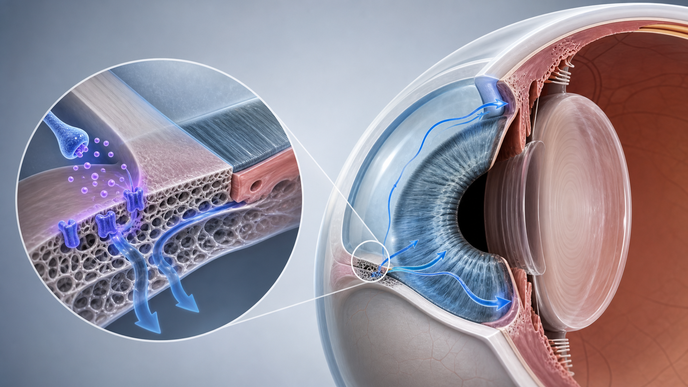
Key Takeaways
- In a preclinical Communications Biology study using human trabecular meshwork cells and mice, norepinephrine signaling was linked to nocturnal IOP elevation through RHOB in the eye's drainage pathway.
- Shared gene-expression changes after norepinephrine exposure highlighted RHOB as the main candidate mediator across human trabecular meshwork cells and mouse eyes.
- RHOB loss was associated with improved particle uptake and clearance in human trabecular meshwork cells, while higher RHOB was associated with lower cleaning activity and fluid movement.
- RHO-ROCK pathway inhibition reduced the nighttime IOP rise in mice, supporting the possibility that daytime measurements may miss pressure elevations that occur overnight.
In Japan, Keisuke Ikegami and colleagues at Kyushu University reported in Communications Biology a preclinical program that combined human trabecular meshwork cells with mouse models. They compared gene-activity changes after norepinephrine exposure in human trabecular meshwork cells and mouse eyes, and then focused on RHOB as a shared signal in the drainage pathway. The mouse experiments also tested RHO-ROCK pathway inhibitors to determine whether RHOB-related signaling changed nocturnal pressure patterns in vivo.
Across species, 18 genes increased in both human trabecular meshwork cells and mouse eyes after norepinephrine exposure, with RHOB emerging as the leading shared candidate mediator. Norepinephrine increased RHOB in trabecular meshwork cells. In human trabecular meshwork cells, removing RHOB increased particle uptake and clearance; increasing RHOB was also reported to reduce cleaning activity and fluid movement, although the experimental system for that latter finding was not clearly specified. In mice, RHO-ROCK pathway inhibitors reduced the nighttime rise in IOP.
The findings were preclinical. Sample size and the exact magnitude of IOP change were not specified in the material reviewed, so the effect size cannot be quantified here. Determining the most effective time of day for ROCK-inhibitor administration, and clarifying how these agents alter IOP rhythm, remain open questions for future study.
RHOB-mediated changes in the trabecular meshwork offer a mechanistic explanation for nocturnal pressure elevations that daytime measurement may miss.
Clinician Questions
Which parts of the RHOB-glaucoma pathway were shown in human trabecular meshwork cells and which were shown in mice?
The norepinephrine gene-expression comparison involved human trabecular meshwork cells and mouse eyes. The report says RHOB removal improved particle uptake and clearance in human trabecular meshwork cells, while increased RHOB was associated with reduced cleaning activity and fluid movement in the eye without clearly specifying the experimental system; the reduction in nocturnal IOP after RHO-ROCK inhibition was reported in mice.
What remains unresolved about the timing of ROCK inhibitor use for nocturnal IOP control?
Determining the most effective time of day for ROCK-inhibitor administration, and understanding how these agents alter IOP rhythm, remain open questions in this preclinical glaucoma study.
Did the available glaucoma report quantify how much nocturnal IOP fell after RHO-ROCK inhibition?
No. A reduction in the nighttime IOP rise in mice after RHO-ROCK inhibition was reported, but sample size, exact IOP change values, confidence intervals, and p-values were not specified in the material reviewed, so the magnitude of the effect cannot be stated here.