
Remote Rehabilitation After ICU Does Not Improve 8-Week Quality of Life
Key Takeaways
- The 8-week EQ-5D-5L utility endpoint was not clearly improved overall, although rehabilitation produced a numerically higher mean score than standard care.
- Several secondary measures favored the remote program, including sit-to-stand performance, fatigue, anxiety, and acceptability.
- The 6-month EQ-5D-5L utility score favored rehabilitation; serious adverse events were rare and unrelated, and a ventilation-duration interaction was reported without an age interaction.
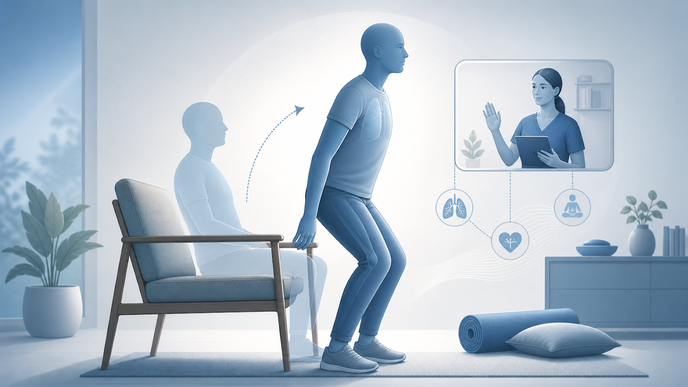
Conducted at 52 UK National Health Service hospitals from December 2022 to November 2025, the trial enrolled adults within 12 weeks of hospital discharge after an ICU admission requiring at least 48 hours of ventilation. Of 3705 screened, 429 were randomized, with 231 assigned to rehabilitation and 198 to standard care; mean discharge-to-randomization time was 57.4 and 57.9 days. Rehabilitation lasted 6 weeks and included individualized weekly one-to-one remote sessions, invited weekly group exercise and peer-support sessions, symptom management, targeted activity, psychological support, and mailed manuals. Each participant worked with a trained specialist supported by a multiprofessional team, while standard care was delivered through the NHS and sites offering similar programs were excluded.
At 8 weeks, sit-to-stand scores were 10.6 versus 9.9, with an adjusted mean difference of 1.0 (95% CI, 0.3 to 1.6; P=.01). FACIT-F fatigue scores were 57.3 versus 53.9, with an adjusted mean difference of 6.1 (95% CI, 1.8 to 10.5; P=.01). HADS anxiety scores were 7.4 versus 8.4, with an adjusted mean difference of -1.0 (95% CI, -1.8 to -0.2; P=.01). Acceptability totals were 4.2 versus 3.5, with an adjusted mean difference of 0.8 (95% CI, 0.6 to 1.0; P<.001); secondary analyses were exploratory and unadjusted for multiplicity. EQ-5D-5L visual analog scale, illness perception, and depression did not differ, while several functional and symptom measures favored rehabilitation.
Among participants with available data, the 6-month EQ-5D-5L utility score was 0.71 versus 0.67, adjusted mean difference 0.08 (95% CI, 0.03 to 0.13; P=.003). No significant difference in the primary outcome was detected across age subgroups. A prespecified interaction by ventilation duration was also reported, with benefit concentrated in participants ventilated 7 days or less. The interaction estimate was adjusted mean difference -0.11 (95% CI, -0.21 to -0.01; P=.03), reflecting differential effects within the trial rather than a subgroup treatment rule.
Among intervention participants with 8-week outcome data, 88% were fully adherent, 9% partially adherent, and 3% nonadherent, while fidelity remained above 80% throughout. Overall, 83 participants reported 121 adverse events, with 100 reports in rehabilitation and 21 in standard care. Four adverse events were definitely or possibly related, and three serious adverse events occurred, none attributed to the intervention; greater contact likely increased event capture. The remote program was feasible to deliver and was linked to several secondary benefits, while the prespecified 8-week quality-of-life endpoint was not clearly improved overall.