
Remimazolam-Esketamine Lowers ERCP Sedation Adverse Events
Key Takeaways
- Among older adults undergoing elective ERCP, composite sedation-related adverse events were lower with remimazolam-esketamine than with propofol-fentanyl, 17.5% versus 35%, and the difference was statistically significant.
- Anesthetic regimen success remained similarly high with remimazolam-esketamine and propofol-fentanyl, at 97.5% versus 98.8%.
- Recovery showed a tradeoff, with longer induction under remimazolam-esketamine but shorter time to eye opening and modified Aldrete recovery.
- Injection pain was less frequent with remimazolam-esketamine, while tachycardia, hypertension, and psychotomimetic symptoms were numerically higher on small event counts.
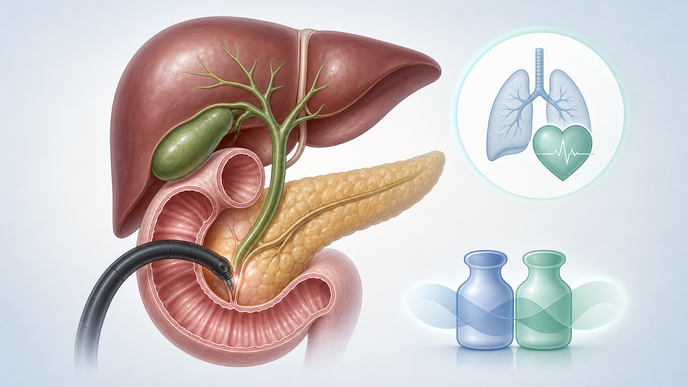
At The Fourth Affiliated Hospital of Anhui Medical University in China, investigators conducted a single-center, prospective, randomized, parallel-group superiority trial. They randomized 160 adults aged 60 to 80 years with American Society of Anesthesiologists (ASA) physical status I to III who were scheduled for elective diagnostic or therapeutic ERCP in a 1:1 ratio; eligibility required body mass index (BMI) 18 to 28 kg/m2 and no anticipated difficult airway, and major exclusions included severe cardiopulmonary dysfunction and ASA IV or V.
The treating anesthesiologist was unblinded, 24-hour postoperative assessment was independent, and both groups received identical nasopharyngeal airway placement, oxygen delivery, capnography, and stepwise rescue algorithms. The primary endpoint was a composite of sedation-related adverse events from induction to endoscope withdrawal, defined by prespecified hypotension, bradycardia, hypoxemia, or respiratory depression criteria.
The lower event rate with remimazolam-esketamine corresponded to a risk ratio of 0.50 (95% CI 0.29–0.88), a risk difference of −17.5 percentage points (95% CI −30.9 to −4.1), and P=0.016; the adjusted risk ratio was 0.49 (95% CI 0.31–0.78), P=0.003. Across the procedure, mean arterial pressure (MAP), heart rate (HR), peripheral oxygen saturation (SpO2), and respiratory rate were directionally more stable with remimazolam-esketamine, with group-by-time interactions for all four measures at P<0.001.
Procedural completion remained similarly high between groups, and no patient required unplanned tracheal intubation. Induction took longer with remimazolam-esketamine, whereas eye opening and time to modified Aldrete recovery were shorter, with no clear difference in post-anesthesia care unit (PACU) stay. Body movement, coughing, additional sedation, ERCP duration, postoperative nausea and vomiting, dizziness, nasal discomfort, and emergence agitation also showed no clear between-group differences. Injection pain was less frequent with remimazolam-esketamine, but tachycardia, hypertension, and psychotomimetic symptoms were numerically more common on small event counts. Exploratory analyses showed lower circulatory, respiratory, treatment-needed, and severity-graded sedation-related adverse events as supportive patterns rather than confirmatory results.
Interpretation is limited by the single-center Chinese setting, relatively fixed anesthesia and endoscopy teams, unblinded intraoperative personnel, and a selected lower-risk older population that excluded BMI outside 18 to 28 kg/m2, anticipated difficult airway, severe cardiopulmonary dysfunction, and ASA IV or higher. The composite endpoint pooled events of differing severity, and the trial was powered for the composite rather than for individual components, uncommon adverse reactions, or subgroup conclusions. Holm-adjusted component comparisons were not significant, and decomposition, treatment-needed, subgroup, no-event success, and severity analyses were supportive and hypothesis-generating.
The authors concluded that, in this selected older ERCP population managed with the same airway-support protocol, remimazolam-esketamine was associated with fewer composite sedation-related adverse events than propofol-fentanyl while maintaining similar procedural completion. They also described a tradeoff of slower induction, somewhat faster early recovery, less injection pain, and uncertain small-count signals for tachycardia, hypertension, and psychotomimetic symptoms.
Clinician Questions
Which ERCP patients were represented in the remimazolam-esketamine trial, and which higher-risk groups were not included?
The trial enrolled adults aged 60 to 80 years with ASA I–III, BMI 18–28 kg/m2, and elective diagnostic or therapeutic ERCP with no anticipated difficult airway. Major exclusions included severe cardiac, cerebral, renal, or pulmonary dysfunction, severe respiratory disease, ASA IV or V, difficult airway, cognitive impairment, and selected other risks, so the findings reflect a selected lower-risk older ERCP population rather than all elderly patients.
How did the trial define a composite sedation-related adverse event during ERCP?
From anesthesia induction to endoscope withdrawal, a patient counted once if any prespecified hypotension, bradycardia, hypoxemia, or respiratory depression criterion occurred. The reported thresholds were MAP <65 mmHg, at least a 20% MAP drop lasting at least 1 minute, or vasoactive medication for hypotension; HR <50 beats/min lasting at least 1 minute or atropine use for bradycardia; SpO2 <90% for at least 10 seconds for hypoxemia; and absent visible chest movement or loss of end-tidal carbon dioxide waveform for at least 20 seconds or a need for mask positive-pressure ventilation for respiratory depression.
Did the lower adverse-event rate identify remimazolam or esketamine as the active driver of benefit?
No. The comparison was between two complete anesthetic regimens—remimazolam plus esketamine versus propofol plus fentanyl—while airway management was held constant. Because both the hypnotic and analgesic drugs differed between groups, the findings apply to the full regimen strategy and do not isolate the independent contribution of any single drug.
Were the component adverse events and exploratory analyses definitive in elderly ERCP sedation?
No. The trial was powered for the composite endpoint, not for confirmatory conclusions about each individual event type, uncommon adverse reactions, or subgroups. Holm-adjusted component comparisons were not significant, and lower circulatory, respiratory, treatment-needed, no-event-success, and severity findings were described by the authors as supportive and hypothesis-generating rather than confirmatory.