
Randomized Shunt Trial in iNPH Shows Gait Benefit
Key Takeaways
- Open shunting was associated with greater 3-month improvement in gait velocity than the placebo valve setting in this drainage-responsive group.
- Tinetti scores favored open shunting, while MoCA and Overactive Bladder Questionnaire scores did not show the same pattern.
- Falls were more frequent with placebo, whereas subdural bleeding and positional headaches were more frequent with open shunting, and cerebral bleeding was reported equally.
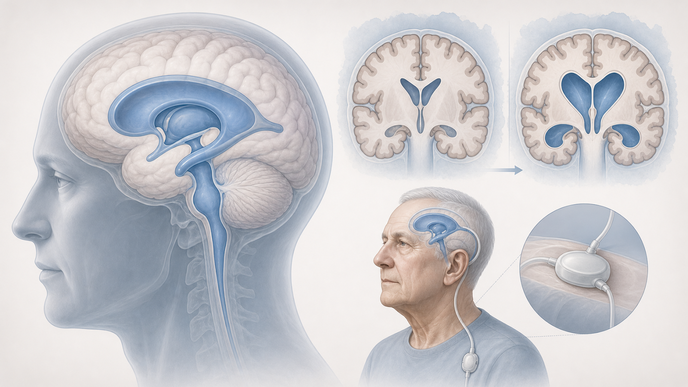
This double-blind, randomized, placebo-controlled trial enrolled adults with idiopathic normal-pressure hydrocephalus and randomized 99 participants, all of whom received the assigned intervention. Eligibility depended on gait-velocity improvement after cerebrospinal fluid drainage, which defined the subgroup examined in the trial. Investigators compared a noninvasively adjustable shunt set to an opening pressure of 110 mm of water with a placebo valve set above 400 mm of water. The primary outcome was the change in gait velocity 3 months after surgery, with 49 participants assessed in each group at that time point. The randomized comparison focused on a selected population defined by response to temporary CSF drainage.
At 3 months, gait velocity changed by 0.23±0.23 m per second with open shunting and 0.03±0.23 m per second with placebo. The Tinetti scale total score improved by 2.9 points with open shunting and 0.5 points with placebo, a between-group difference reported as significant with P=0.003. MoCA changes were 1.3 and 0.3 points, and Overactive Bladder Questionnaire changes were −3.3 and −1.5 points. These secondary measures did not mirror the gait findings across domains. In this selected population, gait velocity and a measure of gait and balance improved significantly more with open shunting, while cognition and incontinence did not show significant between-group differences.
Adverse events moved in different directions across the two groups over 3 months. Falls were more common with placebo than with open shunting, affecting 46% and 24% of participants, respectively. Cerebral bleeding occurred in 2% of participants in both groups, while subdural bleeding occurred in 12% with open shunting and 2% with placebo. Positional headaches were also more frequent with open shunting, reported in 59% versus 28% of participants. Over 3 months, efficacy and safety signals did not move in the same direction.
The reported findings reflect 3 months of follow-up in participants who improved after temporary cerebrospinal fluid drainage. Within that selected group, the 3-month pattern favored shunting for gait-related outcomes but not for cognition or incontinence.