
Prenatal Cannabis and Tobacco Co-Exposure and Child Cognition
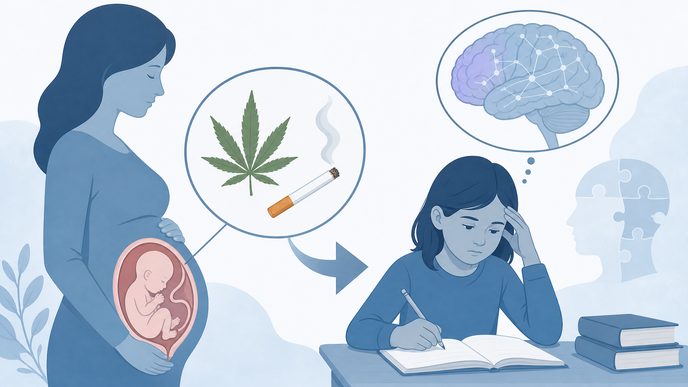
Key Takeaways
- Among U.S. children aged 9–11, reported prenatal cannabis-plus-tobacco exposure showed a statistically significant interaction for fluid cognition.
- Cannabis-only and unexposed children had significantly higher fluid cognition scores than co-exposed children.
- The fluid cognition difference between tobacco-only and co-exposed children was not statistically significant, without establishing equivalence.
- Neither the exposure interaction nor any comparison with co-exposed children was statistically significant for crystallized cognition.
Investigators conducted an exploratory cross-sectional prenatal cannabis and tobacco co-exposure analysis of U.S. Adolescent Brain Cognitive Development (ABCD) baseline observations. The analysis included 8,706 children aged 9–11, classified using retrospective maternal or caregiver yes-or-no reports of prenatal exposure: 236 with co-exposure, 195 with cannabis-only exposure, 803 with tobacco-only exposure, and 7,472 with neither exposure. Comparator groups had reported cannabis-only, tobacco-only, or neither exposure. Fluid and crystallized scores came from the National Institutes of Health (NIH) Toolbox cognitive battery. Covariate-adjusted linear mixed-effects models tested the cannabis-by-tobacco interaction and compared each group with co-exposed children; investigators selected covariates a priori using a directed acyclic graph.
For fluid cognition, investigators found an adjusted cannabis-by-tobacco interaction of β −2.08 points (95% confidence interval [CI] −4.13 to −0.03), a statistically significant finding. The authors characterized standardized effects as small and the interaction estimate as uncertain, with its confidence interval only narrowly excluding zero. This model interaction describes a difference in the pattern of scores associated with reported prenatal exposures when both were present. It does not establish that the substances interact biologically or that either exposure caused a change in cognition.
With co-exposed children as the reference group, children in the cannabis-only group had significantly higher adjusted fluid scores (β +2.13 points; 95% CI +0.21 to +4.05). Unexposed children also had significantly higher fluid scores (β +1.39 points). The tobacco-only fluid contrast, the crystallized interaction, and all three crystallized contrasts with co-exposure were not statistically significant; the tobacco-only finding does not establish equivalence.
Retrospective yes-or-no reports may misclassify prenatal exposure, according to the authors. They also cautioned that shared genetic liability could leave residual confounding and that selection bias may affect interpretation. Because exposure and cognition were compared in an exploratory cross-sectional analysis, the observed associations cannot establish a causal effect. Baseline cognitive scores also do not determine how an individual child’s abilities will develop.
The authors interpreted reported co-exposure as associated with poorer fluid, but not crystallized, cognition relative to cannabis-only exposure or no exposure. Their interpretation is limited to the measured cognitive domains and groups compared.
Clinician Questions
Does the ABCD prenatal cannabis and tobacco co-exposure category measure dose or when use occurred?
In the U.S. ABCD children’s cognition analysis, retrospective maternal or caregiver yes-or-no reports classified prenatal cannabis and tobacco exposure. The binary co-exposure category does not quantify either substance’s dose or when use occurred.
Did prenatal cannabis and tobacco co-exposure predict changes in children's cognition over time?
No cognitive change over time was analyzed among children with reported prenatal cannabis and tobacco co-exposure in the ABCD cohort. The association concerns fluid cognition assessed at ages 9–11 in a cross-sectional baseline analysis of an ongoing cohort, not an individual child’s future cognitive trajectory.
This content is intended for healthcare professionals for educational purposes. The article and its image were developed with AI assistance and reviewed by members of the ReachMD team prior to publication. Please refer to the original source linked for the complete and most up-to-date information.