
PORTEC-4a Trial Reports Molecular Profile Guided Adjuvant Treatment
Key Takeaways
- Five-year vaginal recurrence was numerically higher with the molecular-profile strategy, although the prespecified non-inferiority criterion was met.
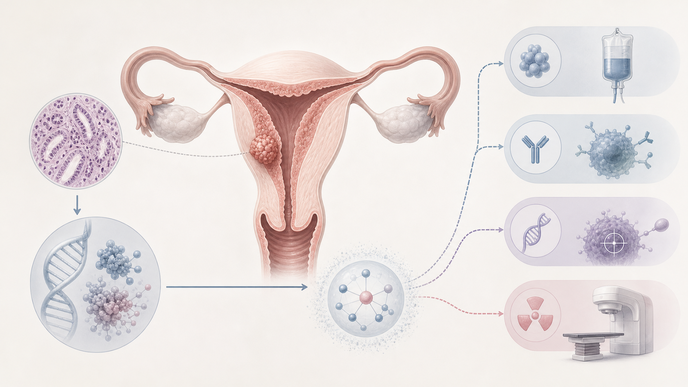
- Favorable profiles were assigned observation, intermediate profiles brachytherapy, and unfavorable profiles pelvic radiotherapy.
- Adverse events were mainly grade 1–2, severe genitourinary toxicities were uncommon in both groups, and the investigators described the strategy as safe and effective.
PORTEC-4a was a randomized, open-label, phase 3, multicenter, non-inferiority trial across eight European countries. Eligible women were aged 18 years or older, had WHO performance status 0–2, and had early stage high-intermediate risk endometrial cancer after surgery. Patients were assigned in a 2:1 ratio to molecular integrated risk profile-guided adjuvant treatment or standard vaginal brachytherapy, using biased-coin minimization with stratification for centre, grade, and lymphadenectomy. The final eligible and evaluable cohort included 564 patients, with 367 in the molecular-profile group and 197 in the standard group, and median follow-up was 58.1 months. Within the molecular-profile group, 168 patients had favorable profiles, 148 intermediate profiles, and 51 unfavorable profiles, corresponding to observation, brachytherapy, and pelvic radiotherapy.
The primary endpoint was overall 5-year cumulative incidence of vaginal recurrence as the first event. In the final analysis, rates were 4.5% in the molecular-profile group and 1.6% in the standard group, with a hazard ratio of 2.71. The upper bound of the one-sided confidence interval for the difference was 5.3%, below the predefined 7.0% margin. The p value for non-inferiority was 0.005, supporting the trial’s prespecified non-inferiority conclusion. In the favorable-profile analysis, 5-year vaginal recurrence was 4.1% versus 0.9%, with a hazard ratio of 3.97.
Adverse events were mainly grade 1–2, with no substantial safety differences between groups. Grade 3 or higher related genitourinary toxicities occurred in four patients (1%) in the molecular-profile group and four patients (2%) in the standard group. Five serious adverse events occurred overall, including one case of vaginal scar dehiscence that was possibly treatment related. No treatment-related deaths were reported during follow-up.
The investigators described the molecular-profile strategy as safe and effective and said it spared 46% of favorable-profile patients from adjuvant treatment while reducing overtreatment and undertreatment overall.