
pNPWT Cuts SSI After High-Risk Open Abdominal Surgery
Key Takeaways
- In high-risk adults undergoing open abdominal surgery at a single hospital in China, 30-day Centers for Disease Control and Prevention-classified surgical-site infection was lower with prophylactic negative-pressure wound therapy than with standard dressings, at 5.3% versus 35.6%.
- Prophylactic negative-pressure wound therapy was associated with faster complete epithelialization and a shorter postoperative hospital stay than standard dressings.
- Three-month scar outcomes favored prophylactic negative-pressure wound therapy, with lower Vancouver Scar Scale scores and higher patient-reported scar satisfaction.
- Higher body mass index and longer incision length were associated with greater surgical-site infection risk; the authors also report that higher glycated hemoglobin was independently associated with greater SSI risk and was included with treatment group, body mass index, and incision length in the nomogram.
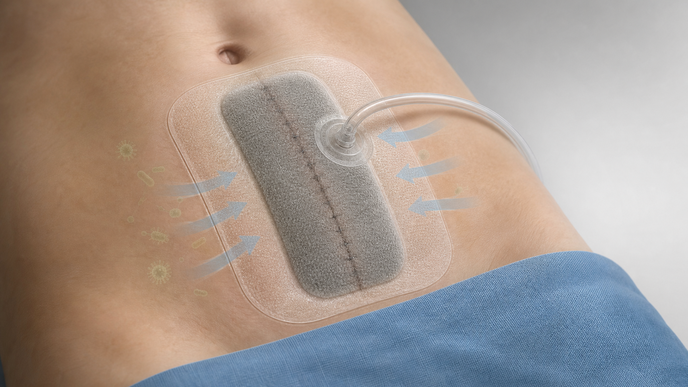
In a retrospective cohort study of prophylactic negative-pressure wound therapy in high-risk open abdominal surgery at Zhejiang Provincial People's Hospital in China from January 1, 2022, through December 31, 2024, investigators included 83 adults aged 18 to 75 years; 38 received prophylactic negative-pressure wound therapy (pNPWT) and 45 received standard dressings. High-risk eligibility required at least one preoperative factor: body mass index (BMI) ≥ 28 kg/m2, Type II diabetes mellitus, chronic systemic corticosteroid therapy, or emergency surgery. The pNPWT group received a Prevena device immediately after fascial closure at −125 mmHg continuous suction for 5–7 days without routine dressing changes unless clinically indicated, whereas controls received dry gauze or foam dressings changed every 48 hours. The primary endpoint was 30-day Centers for Disease Control and Prevention (CDC)-classified surgical-site infection (SSI), captured through retrospective chart review plus clinic follow-up, emergency visits or readmissions, and telephone follow-up when needed. Secondary outcomes were wound dehiscence, time to complete epithelialization, postoperative length of stay, 30-day wound-related readmission, Vancouver Scar Scale (VSS) score at about 3 months, and 10-point visual analogue scale (VAS) scar satisfaction. Treatment assignment reflected surgeon preference and device availability rather than randomization.
Baseline characteristics were broadly comparable between groups. Thirty-day SSI occurred in 5.3% of the pNPWT group versus 35.6% of the standard-dressing group (p = 0.002). Complete epithelialization was achieved in 10.2 [8.90–11.4] days with pNPWT versus 14.5 [12.3–17.7] days with standard dressings (p < 0.001). Postoperative stay and 3-month scar measures also favored pNPWT, whereas wound dehiscence and wound-related readmission did not differ significantly.
After adjustment, pNPWT retained a protective association with SSI (adjusted OR 0.030, 95% CI 0.001–0.298; p = 0.011). Higher body mass index and longer incision length were independently associated with greater SSI risk, and the authors report that higher glycated hemoglobin (HbA1c) was also independently associated with greater SSI risk, whereas diabetes did not remain significant after adjustment. The authors used those four variables—treatment group, body mass index, glycated hemoglobin, and incision length—to construct the nomogram.
The nomogram showed an area under the curve (AUC) of 0.990 in the training cohort and 0.929 in internal validation. Calibration error was low in both datasets, and decision-curve analysis suggested net benefit across a broad range of threshold probabilities.
Because this was a retrospective, single-center, nonrandomized cohort from one hospital in China, with treatment selection shaped by surgeon preference and device availability, confounding by indication and selection or information bias remain possible. The authors also identified incompletely documented intraoperative factors, including wound contamination class, bowel spillage or enterotomy, and mesh use, as important unadjusted sources of uncertainty, and the nomogram was derived from only 18 SSI events with internal validation alone.
In this single-center Chinese cohort, pNPWT was linked to lower SSI rates and faster wound recovery in high-risk open abdominal surgery, while broader use of the prediction model still awaits external validation.
Clinician Questions
Which patients counted as high risk in this pNPWT abdominal surgery cohort?
Adults aged 18 to 75 years undergoing open abdominal surgery at Zhejiang Provincial People's Hospital were considered high risk if they had at least one preoperative risk factor: BMI ≥ 28 kg/m2, Type II diabetes mellitus, chronic systemic corticosteroid therapy, or emergency surgery. The cohort excluded patients with pre-existing incision infection, concurrent thoracoabdominal procedures, very early re-operation for non-wound complications, perioperative death within 7 days, major missing data, or loss to 30-day follow-up.
How was 30-day SSI defined and captured after high-risk open abdominal surgery in this cohort?
Thirty-day SSI was classified by Centers for Disease Control and Prevention criteria as superficial, deep, or organ-space infection. Investigators identified events retrospectively from inpatient and outpatient notes, discharge summaries, microbiology and imaging reports, antibiotic treatment records, clinic follow-up, emergency visits or readmissions within 30 days, and telephone follow-up when clinic documentation was unavailable.
What limits the nomogram’s usefulness outside this high-risk open abdominal surgery dataset?
The four-variable nomogram was derived from a single-center retrospective cohort with only 18 SSI events and internal validation only, so its apparent performance may not hold in other settings. Treatment assignment to pNPWT or standard dressings was not randomized, and important intraoperative factors such as wound contamination class, bowel spillage or enterotomy, and mesh use were not uniformly documented, which limits generalizability until external validation is available.