
Phase III PDT Improves Superficial Basal Cell Carcinoma Clearance
Key Takeaways
- In adults with naïve superficial basal cell carcinoma in a US phase III setting, red light PDT with 10% aminolevulinic acid gel was associated with significantly higher histological clearance than vehicle.
- Clinical clearance was also significantly higher with 10% aminolevulinic acid gel than with vehicle.
- The authors reported a positive esthetic outcome with 10% aminolevulinic acid gel PDT.
- The study characterized safety as unproblematic.
- Few face or scalp lesions were represented, and long-term follow-up remained in progress.
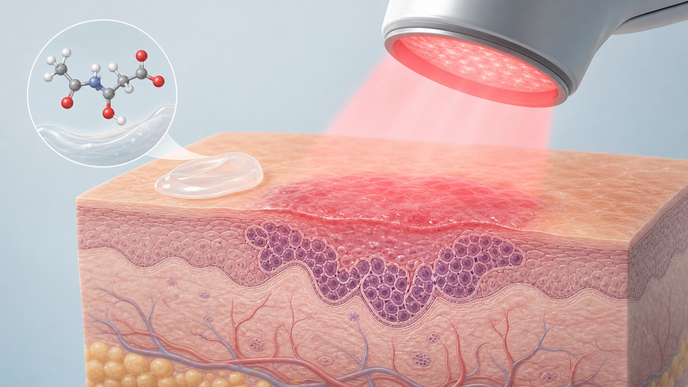
In the phase III trial of red light PDT with 10% aminolevulinic acid gel in superficial basal cell carcinoma, adults with at least one naïve superficial basal cell carcinoma entered a randomized, double-blind, vehicle-controlled study conducted at 21 US centers, registered as ClinicalTrials.gov NCT03573401. Participants received photodynamic therapy (PDT) with 10% 5-aminolevulinic acid (ALA) gel or vehicle in 1 to 2 treatment cycles, with 2 PDT sessions in each cycle.
Clinical and histological assessment occurred 12 weeks after the start of the last PDT cycle. Among 187 randomized participants, 145 were assigned to PDT with 10% ALA gel and 42 to vehicle. Histological clearance was 75.9% with 10% ALA gel versus 19% with vehicle (P < .0001). Clinical clearance was 83.4% versus 21.4%, and this comparison was also reported as P < .0001. The authors reported a positive esthetic outcome with 10% ALA gel PDT. The authors described safety as unproblematic.
Few participants had lesions on the face or scalp, and 60-month follow-up was still ongoing. The available report therefore centers on early clearance within the enrolled lesion mix rather than on long-term durability or site-specific performance. Because the source details are limited to the abstract, broader comparisons were not described in the reported data.
The authors concluded that 10% ALA gel showed higher clearance than vehicle, with positive esthetic outcome and unproblematic safety in adults with superficial basal cell carcinoma.
Clinician Questions
How well do the phase III results for 10% ALA red-light PDT apply to face or scalp superficial basal cell carcinoma?
Because the phase III trial of red light PDT with 10% ALA gel enrolled few adults with face or scalp superficial basal cell carcinoma, the reported efficacy and safety signal mainly reflects the lesion distribution that was represented rather than site-specific performance at those locations.
What did the vehicle-controlled design show—and not compare—for 10% ALA red-light PDT in superficial basal cell carcinoma?
The randomized, double-blind, vehicle-controlled pivotal phase III trial at 21 US centers showed that red light PDT with 10% ALA gel performed better than vehicle within that study design for adults with superficial basal cell carcinoma, but it did not provide head-to-head results against surgery or another active treatment.
What longer-term question remained open after the 12-week clearance assessment with 10% ALA gel PDT?
Clinical and histological outcomes for red light PDT with 10% ALA gel in superficial basal cell carcinoma were assessed 12 weeks after the start of the last PDT cycle, while 60-month follow-up was still ongoing, so longer-term durability beyond that initial assessment window remained unresolved in the reported data.