
OCT Parameters Detect Glaucoma Progression Across Disease Severity
Key Takeaways
- Structural OCT was associated with more frequent progression detection than visual field testing overall, with the clearest advantage in mild glaucoma.
- Macular ganglion cell layer showed the highest detection rate among the OCT measures evaluated, with global RNFL and macular retinal thickness close behind.
- Survival analysis showed earlier and increasingly divergent detection with OCT over time, and adding functional criteria did not significantly improve detection beyond OCT alone.
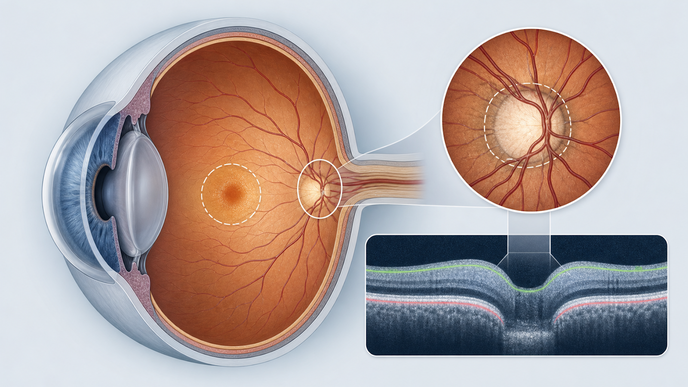
The longitudinal study evaluated 59 glaucoma patients who underwent repeated structural and functional testing over a mean follow-up of 8.51 years. Each patient completed at least 5 serial OCT assessments and 5 visual field assessments during the observation period. Primary structural measures included global RNFL, macular ganglion cell layer, and macular retinal thickness. Progression was defined by significant thinning trends on OCT or worsening visual field indices, specifically mean deviation or pattern standard deviation.
Among structural measures, macular ganglion cell layer had the highest progression detection rate at 61.0%, followed by global RNFL at 59.3% and macular retinal thickness at 57.6%. A macular measure therefore ranked slightly ahead of traditional peripapillary RNFL analysis in this cohort for detecting change. In mild glaucoma, OCT detected progression more often than visual field testing, 87.5% versus 50.0% (p<0.001). Macular ganglion cell layer and inferior macular retinal thickness were more sensitive at earlier stages (p<0.05), while moderate-to-severe disease showed a higher OCT detection rate that was not statistically significant.
Time-to-event comparisons showed that OCT identified progression earlier and more frequently than visual field testing as follow-up continued. The difference also became more pronounced over time, with increasing separation between structural and functional detection curves. By 10 years, structural parameters identified more progressing eyes than visual field testing, 57.0% versus 38.6%. Combining structural and functional criteria did not significantly improve detection beyond OCT alone in this analysis. Overall, structural OCT parameters detected glaucoma progression earlier and more often than visual field testing, especially in mild disease, with macular ganglion cell layer performing strongly alongside RNFL imaging.