
Navarre e-Prescribing Channel Improved Pharmacy–PCP Coordination
Key Takeaways
- In Navarre, Spain, a communication channel inside the electronic prescribing system linked community pharmacies with primary care teams, and by October 2024 it was operating in primary care teams covering 95% of primary healthcare zones and in 100% of community pharmacies.
- During the pilot phase, the authors report that 99% of pilot incidents were resolved within one working day, although they also state that non-urgent communications were expected to be managed over 5 to 10 working days.
- Through November 2025, the channel had been used to communicate 197,292 incidents, with 47% classified as urgent and 53% as non-urgent.
- In a 204-response satisfaction survey, 64% of health centre professionals and 81% of community pharmacists said the channel improved communication between the two settings, and community pharmacists rated work organization and incident-resolution time more favorably.
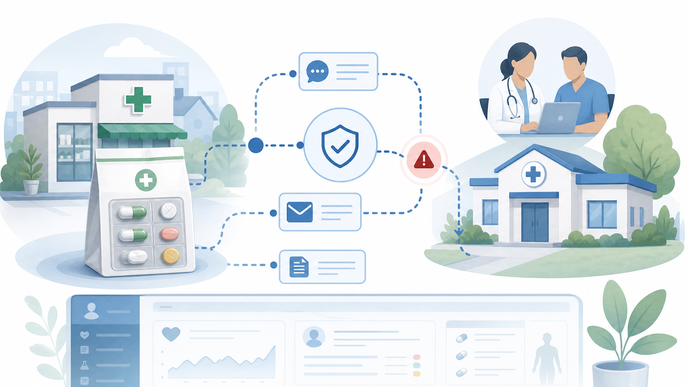
In the Navarra electronic prescribing communication channel implementation study, a multidisciplinary group led by primary care (PC) pharmacists, with community pharmacists, physicians, and information technology support, created the channel and its standard operating procedure (SOP) for community pharmacies (CPs) and primary care teams. The pilot ran in three primary healthcare zones (PHZs) in 2021, one urban and two rural, and classified incidents as urgent or non-urgent. Urgent incidents were assigned a one-working-day response from the primary care team, whereas non-urgent communications were managed over five to ten working days according to local workflows. Using the HC messages tool in the LAMIA system, the community pharmacist selected the destination health centre and urgency category, entered free text, and sent a patient-linked notification that routed through a generic email account and an internal consultation for the responsible professional.
From February to November 2021, the authors report 588 pilot incidents, including 144 urgent and 444 non-urgent reports. Most communications therefore entered the routine rather than accelerated pathway, and nearly all were handled within the planned urgent-response window. The process also shifted from email notification to the LAMIA tool in June 2021, supporting broader regional rollout.
After the pilot, the channel expanded across nearly all participating primary care teams and all community pharmacies in the region. Up to November 2025, 197,292 incidents had been communicated, with 47% classified as urgent and 53% as non-urgent. In the later evaluation, community pharmacists rated work organization and incident-resolution time more favorably than health centre professionals, and communication between settings was commonly described as improved.
The reported benefits were operational and perception-based rather than direct evidence of patient outcomes. The authors noted that patient satisfaction was not assessed, workflows and non-urgent response arrangements varied across PHZs, and bidirectional communication through the same channel was still under development. Because this was a regional implementation in Navarre, Spain, within the LAMIA prescribing system, the findings describe that setting rather than a tested North American model.
According to the authors, the channel facilitated resolution of medication-related incidents identified in community pharmacies and improved interprofessional collaboration, alignment, and trust between community pharmacy and primary care settings. They also identified future evaluation priorities around quantifying professional time investment and patient time saved.
Clinician Questions
What counted as an urgent medication-related incident in the Navarra pharmacy–primary care communication channel?
Urgent medication-related incidents were events that could have clinically relevant consequences if not addressed promptly, including expired prescription validity, outdated dosage regimens that could interrupt treatment, package loss or damage, medicine shortages, inappropriate dosage forms in dysphagia, adverse drug reactions, and other clinically relevant medication-related problems.
How were messages routed from community pharmacies to the responsible primary care team in LAMIA?
In LAMIA, the community pharmacist used the HC messages tool to select the destination health centre and urgency category, entered free text, and sent a patient-linked notification. The message went to a generic primary care email account and also generated an internal consultation for the responsible professional, allowing routing even when the patient’s usual clinician was unavailable.
Could community pharmacists use the communication channel only within their own primary healthcare zone?
No. Communications were not restricted to professionals within the same PHZ, and a community pharmacist could submit an incident to any health centre where the channel had been implemented. The authors described that broader routing as a way to avoid unnecessary patient visits to the designated health centre.
What limitations and unresolved issues remained after the Navarra rollout of the communication channel?
After rollout in Navarre, the authors said the main unresolved issues were that patient satisfaction was not surveyed, local workflows were not fully uniform across PHZs, and bidirectional communication through the same channel was still under development. They also identified future evaluation priorities around quantifying healthcare professional time investment and patient time saved.