
Examining Muscle Mass and Lung Volumes in Older Men in Long-Term Care
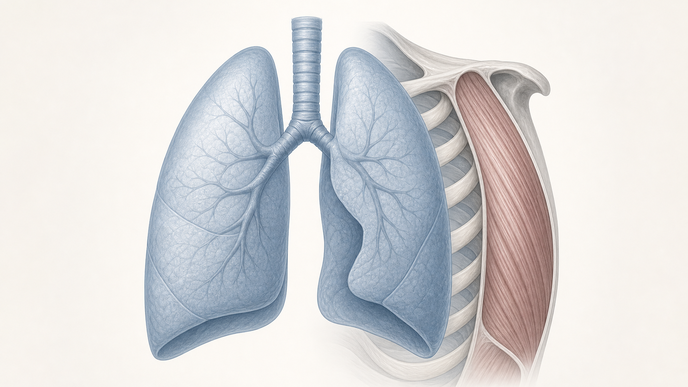
Key Takeaways
- Men in Polish long-term care showed modest but statistically significant positive associations between muscle quantity and absolute lung volumes.
- Trunk skeletal muscle mass showed no statistically significant association in adjusted spirometry models.
- Height alone was statistically significant in the adjusted vital-capacity model.
- The FEV1/VC model was nonsignificant overall despite a significant negative age coefficient within it.
- Positive muscle–volume associations in the oldest men, but not younger men, did not establish an age interaction.
Investigators assessed muscle quantity and breathing performance in clinically stable residents. They conducted a cross-sectional assessment of 58 men aged 60–85 at 15 long-term care facilities in southwestern Poland during 2023–2025; 42 were aged 75 or younger and 16 were older. Permanent residents had to be independently mobile, able to perform basic activities and valid spirometry, and clinically stable; acute illness and serious contraindications were excluded. Multifrequency, eight-electrode segmental bioelectrical impedance analysis (BIA) measured total, trunk, and limb skeletal muscle, intracellular water (ICW), and the extracellular water to total body water ratio (ECW/TBW). Seated spirometry with a nose clip required at least three acceptable, repeatable maneuvers and measured vital capacity (VC), forced vital capacity (FVC), forced expiratory volume in one second (FEV1), and peak expiratory flow (PEF). Investigators modeled FEV1/VC; FEV1/FVC was also listed as a measurement. Pearson or Spearman correlations covered the full sample and exploratory age strata. Four full-sample regressions included trunk skeletal muscle mass (SMMT) alongside age: VC also included height and ICW; FEV1, weight and ECW/TBW; PEF, weight; and FEV1/VC, height.
Absolute VC, FVC, and FEV1 showed weak-to-moderate positive correlations with total, trunk, and lower-limb muscle measures (coefficients 0.25–0.31; p < 0.05). Full-sample muscle correlations with PEF and FEV1/VC were not statistically significant.
SMMT was not statistically significant in any of the four adjusted, outcome-specific models. Height alone was significant in the VC model (standardized β = 0.49; p < 0.001). The adjusted findings do not rule out a physiological relationship between muscle quantity and breathing.
The FEV1/VC model was nonsignificant overall (p = 0.096), despite a negative age partial coefficient (standardized β = −0.33; p = 0.014). That coefficient cannot establish a reliable model-wide association. Exploratory correlations of total and trunk muscle with absolute VC and FVC were positive in the older stratum but not significant in younger men. Only FEV1/VC differed significantly between age groups, with higher values in younger men; differing subgroup significance does not establish an age interaction.
The authors noted that the small oldest stratum yielded imprecise correlations and precluded stable subgroup regression or a reliable formal age-interaction test; exploratory comparisons were not corrected for multiplicity. Selection of mobile, clinically stable men able to complete spirometry limits applicability to frailer residents, women, and other settings. Smoking, activity, cardiopulmonary conditions, medications, and nutrition were incompletely assessed, allowing residual confounding. Concurrent measurements cannot establish causation, subsequent pulmonary decline, or predictive accuracy.
According to the authors, the modest unadjusted muscle–volume pattern did not persist as an independent SMMT finding in the fitted models. They considered the older-stratum pattern hypothesis-generating and called for larger longitudinal studies rather than treating it as confirmed age modification.
Clinician Questions
Did bioelectrical impedance measurements diagnose sarcopenia in older Polish nursing-home men?
The Polish long-term-care investigation measured total and segmental skeletal muscle quantity by bioelectrical impedance. Formal sarcopenia diagnosis also requires assessment of muscle strength alongside low muscle mass, so these associations are not evidence of diagnosed sarcopenia.
How did trunk muscle mass relate to percent-predicted airflow measures in nursing-home men older than 75?
Among institutionalized Polish men older than 75, trunk skeletal muscle mass had exploratory negative correlations with percent-predicted FEV1/VC and peak expiratory flow, unlike its positive association with absolute vital capacity. These concurrent subgroup correlations establish neither a mechanism nor diagnosed airflow obstruction or an age interaction.
This content is intended for healthcare professionals for educational purposes. The article and its image were developed with AI assistance and reviewed by members of the ReachMD team prior to publication. Please refer to the original source linked for the complete and most up-to-date information.