
MRI Accuracy for Knee Meniscus Tears: Updated Meta-Analysis
Key Takeaways
- MRI accuracy was high overall, with sensitivity favoring medial tears and specificity favoring lateral tears.
- The evidence base included 75 studies, 8,507 patients, 8,517 knees, 28 countries, and used arthroscopy as the reference standard.
- Subgroup analyses found lower lateral-tear specificity over time and higher lateral-tear sensitivity when combined diagnostic criteria were used.
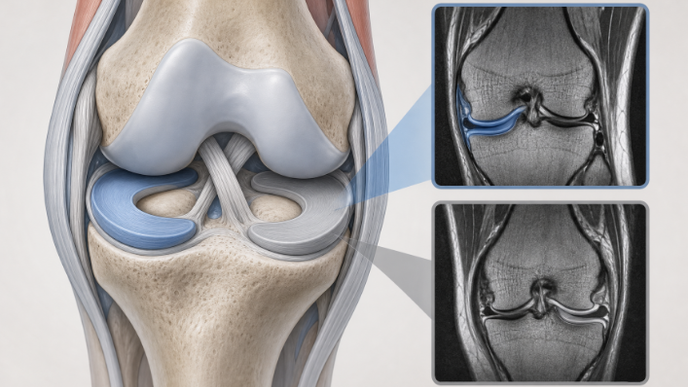
The review examined MRI diagnostic accuracy for native knee meniscal tears compared with arthroscopy as the reference standard. Peer-reviewed studies were identified through PubMed, Scopus, and Embase, spanning publications from 1986 through 2023. Across 28 countries, the evidence base covered 75 studies, 8,507 patients, and 8,517 knees. Random-effects models were used for pooled analyses, and summary receiver operating characteristic analyses were also reported.
Medial and lateral tears were analyzed separately, allowing direct compartment-level comparison. Sensitivity reached 91.0% for medial tears, with a 95% CI of 89.3% to 92.4%, and 78.5% for lateral tears, with a 95% CI of 74.5% to 82.0%. For specificity, lateral tears measured 94.0%, with a 95% CI of 92.5% to 95.3%, while medial tears measured 87.7%, with a 95% CI of 85.2% to 89.8%. The pooled results showed higher sensitivity for medial tears and higher specificity for lateral tears.
Subgroup and meta-regression analyses examined study design, patient characteristics, imaging parameters, and diagnostic criteria, with lateral-tear specificity decreasing over time, with P = .01. For lateral tears, pooled sensitivity was highest at 81.1% when studies used both surfacing linear signal intensity and meniscus distortion, versus 79.2% with signal intensity alone. Studies not reporting criteria had a pooled sensitivity of 60.8% for lateral tears. Meta-regression associated use of both criteria with higher performance versus studies not reporting criteria, adjusted odds ratio 3.74, with a 95% CI of 1.37 to 10.18 and P = .01. Image-count comparisons showed no sensitivity or specificity differences, with P values from .29 to .59, and the overall pattern favored medial sensitivity and lateral specificity.