
MRgFUS Thalamotomy Improves Parkinson Tremor at 6 Months
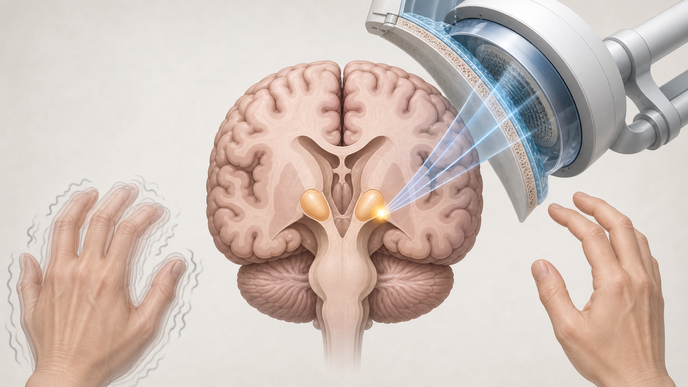
Key Takeaways
- In a prospective single-center observational cohort, 107 patients with Parkinson’s disease underwent unilateral VIM MRgFUS thalamotomy, and tremor and motor scores improved most at 24 hours before partially attenuating and then stabilizing through 6 months.
- Using the study’s prespecified ≥30% response threshold, FTM response rates were 85/98 (86.7%) at 24 hours, 58/94 (61.7%) at 1 month, and 52/92 (56.5%) at 6 months, while MDS-UPDRS-III response rates were 58/96 (60.4%), 37/95 (38.9%), and 26/91 (28.6%) at the same timepoints.
- MMSE and MoCA screening scores were stable over follow-up, levodopa equivalent daily dose decreased significantly by 6 months in the medication-data subset (F=19.992, p<0.001), and reported adverse events were transient with no serious adverse events, permanent neurologic deficits, or procedure-related hospital readmissions.
This prospective, single-center, observational real-world registry enrolled consecutive patients treated between January 2018 and December 2024 at San Salvatore Hospital in L'Aquila, Italy. Of 148 screened patients, 23 were excluded for an SDR below 0.35; 125 began or were scheduled for MRgFUS, and 18 were later excluded, leaving 107 for analysis. Unilateral VIM thalamotomy was performed contralateral to predominant symptoms, technical success required a nidus temperature of at least 55°C, and follow-up for MRgFUS tremor, cognition, and safety outcomes was conducted at baseline, 24 hours, 1 month, and 6 months with FTM and MDS-UPDRS-III assessed in the medication-OFF state. The broader motor trajectory on MDS-UPDRS-III showed the same early-improvement pattern, with a significant time effect of F=34.861, p<0.001, and the overall change was reported to be mainly tremor-driven.
A significant FTM Time × disease duration interaction was observed (F=5.921, p<0.001). Within this selected MRgFUS cohort, longer disease duration was associated with worse baseline tremor severity (B=0.665, p<0.001) and larger early post-procedure improvement, although the authors caution that the baseline association may partly reflect selection bias rather than the natural course of PD tremor; longer disease duration was not associated with higher post-treatment tremor severity during follow-up. Subdomain analyses suggested that the overall motor change was largely tremor-related, while early improvements in rigidity and bradykinesia attenuated over time and axial symptom modulation remained weak. This pattern kept the longitudinal signal centered on tremor rather than broad antiparkinsonian change.
In the subset with medication data, levodopa equivalent daily dose declined from baseline to 6 months with F=19.992, p<0.001. Screening cognition remained stable, with MMSE showing F=1.272, p=0.287 and MoCA showing F=1.073, p=0.345, although longitudinal cognitive availability was incomplete and assessment relied on screening measures rather than detailed neuropsychological testing. Reported MRI- or ultrasound-related events included dizziness 5%, scalp burning 4%, headache 3%, and vasovagal reactions 1%, while thalamotomy-related events included paresthesias 5%, contralateral weakness 4%, gait instability 3%, and dysgeusia 1%; the cohort was monocentric, uncontrolled, and followed for 6 months, and all reported adverse events resolved during follow-up. Across 6 months, unilateral MRgFUS thalamotomy was associated with sustained tremor benefit without measurable change on screening cognition and without permanent neurologic complications.
Clinician Questions
What motor changes were reported over 6 months after MRgFUS thalamotomy for Parkinson's tremor?
In patients with tremor-dominant Parkinson’s disease and severe, medically refractory tremor, unilateral VIM MRgFUS thalamotomy was associated with the greatest improvement in FTM and MDS-UPDRS-III scores at 24 hours, followed by partial attenuation at 1 month, with scores still below baseline at 6 months and no significant difference between 1 and 6 months.
How often did patients meet a 30% response threshold after MRgFUS thalamotomy in Parkinson's disease?
In patients with Parkinson's disease after MRgFUS thalamotomy, the reported ≥30% response rates were 86.7% for FTM at 24 hours, 61.7% at 1 month, and 56.5% at 6 months, and 60.4%, 38.9%, and 28.6% for MDS-UPDRS-III at the same timepoints; these were the study's reported response rates at each assessment, not treatment recommendations.
Were cognition and levodopa requirements changed after MRgFUS thalamotomy in Parkinson's disease?
In patients with Parkinson's disease after MRgFUS thalamotomy, screening cognition remained stable on MMSE and MoCA over follow-up, while levodopa equivalent daily dose decreased significantly from baseline to 6 months in the subset of patients with available medication data.
What adverse events were reported after MRgFUS thalamotomy for Parkinson's disease tremor?
After MRgFUS thalamotomy for Parkinson's disease tremor, MRI- or ultrasound-related adverse events included dizziness 5%, scalp burning 4%, headache 3%, and vasovagal reactions 1%, while thalamotomy-related adverse events included paresthesias 5%, contralateral weakness 4%, gait instability 3%, and dysgeusia 1%; these events resolved during follow-up, and no serious adverse events, permanent neurologic deficits, or procedure-related hospital readmissions were observed.