
Molecular Profiling Guides Adjuvant Therapy in Endometrial Cancer
Key Takeaways
- Non-inferiority for vaginal recurrence was reported, although recurrence was numerically higher with molecular-profile guided treatment.
- Favorable profiles were assigned to observation, intermediate profiles to brachytherapy, and unfavorable profiles to pelvic radiotherapy.
- Adverse events were mainly grade 1 or 2, serious events were uncommon, and the authors said the strategy spared many favorable-profile patients from adjuvant treatment.
This randomized, open-label, phase 3, multicenter, non-inferiority trial was conducted across eight European countries. Eligible participants were women aged 18 years or older with WHO performance score 0-2 and early-stage high-intermediate-risk endometrial cancer. After surgery, patients were assigned in a 2:1 ratio to molecular-integrated-risk-profile guided adjuvant treatment or standard vaginal brachytherapy, using biased-coin minimization stratified by center, grade, and lymphadenectomy. After the addition of 23 favorable patients from PORTEC-4, the final combined cohort included 564 eligible and evaluable patients, with 367 in the molecular-profile group and 197 in the standard group. The primary endpoint was overall 5-year cumulative incidence of vaginal recurrence as the first event in the intention-to-treat population.
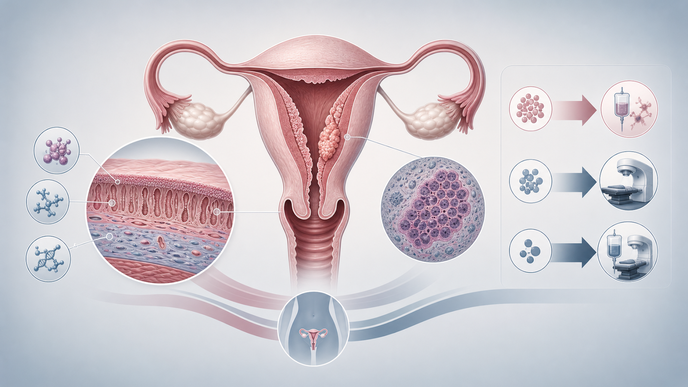
In the molecular-profile group, favorable profiles were assigned to observation, intermediate profiles to brachytherapy, and unfavorable profiles to pelvic radiotherapy. Favorable profiles were POLE-mutated or NSMP-CTNNB1 wildtype, intermediate profiles were mismatch repair deficient or NSMP-CTNNB1 mutated, and unfavorable profiles included p53-abnormal tumors, substantial lymphovascular space invasion, or L1CAM overexpression. Median follow-up was 58.1 months, and among 367 patients the molecular-profile distribution was 168 favorable, 148 intermediate, and 51 unfavorable cases. The recurrence hazard ratio was 2.71, and the one-sided upper confidence-bound difference was 5.3%, below the predefined 7.0% equivalence margin, with pnon-inferiority of 0.005.
In the favorable-profile subset, 5-year vaginal recurrence was 4.1% in the molecular-profile group and 0.9% with standard brachytherapy, with a hazard ratio of 3.97. Adverse events were mainly grades 1-2 in both groups. Grade 3 or higher related genitourinary toxicities occurred in four patients, or 1%, in the molecular-profile group and four, or 2%, in the standard group. Five serious adverse events occurred overall, one was possibly treatment related vaginal scar dehiscence, and no treatment-related deaths were reported. Safety signals were limited, and serious treatment-related events were rare.
The authors concluded that molecular integrated risk profile-guided adjuvant treatment was safe and effective in this population. They said this approach spared patients with a favorable profile from adjuvant treatment; 46% of patients in the molecular-profile group had a favorable profile. The investigators also linked the strategy to less overtreatment and undertreatment. Follow-up was ongoing, and the trial was registered in three public registries. The findings remained within a non-inferiority comparison rather than a claim of superiority.