
MECP2 Reading Frame Distinguishes Benign From Pathogenic CTDs
Key Takeaways
- Among MECP2 C-terminal deletions in Rett syndrome, reading frame and the resulting terminal motif, rather than truncation alone, distinguished benign from pathogenic variants.
- Benign-style +1-frame CTDs were enriched in the general-population database, whereas pathogenic-style +2-frame CTDs predominated in the Rett syndrome mutation database.
- CTD3 c.1158_1167del behaved like a benign allele in mice, with wildtype-range MeCP2 expression, survival through 1 year, and no RTT-like phenotype.
- Replacing the pathogenic CTD1 stop codon with tryptophan restored MeCP2 expression and removed RTT-like phenotypes in mice.
- Adenine base editing provided an efficient preclinical proof of concept in cultured CTD transgenes rather than a clinical intervention.
In MECP2 C-terminal frameshift deletions in Rett syndrome, investigators examined C-terminal deletions (CTDs), which account for approximately 10% of Rett syndrome (RTT)-causing mutations and cluster in the c.1110-c.1210 C-terminal deletion-prone region (CT-DPR), removing about 100 amino acids from the tail. The integrated design combined gnomAD v4.1.0 and RettBASE data, a multigeneration family carrying c.1159_1210del, mouse knock-in alleles including CTD1, CTD2, and CTD3, mouse embryonic stem cell (mESC)-derived neurons, inducible Flp-In T-REx transgene models, and adenine base editing (ABE) assays. High-confidence pathogenic alleles were RettBASE entries with classical RTT and at least one de novo occurrence, whereas high-confidence benign alleles were gnomAD variants seen in at least one hemizygous male.
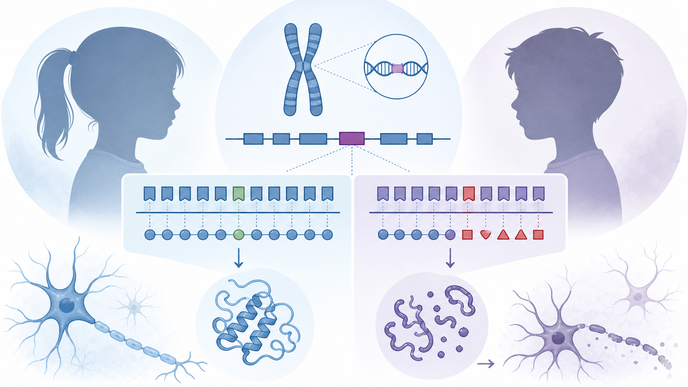
Across the human datasets, benign high-confidence CTDs uniformly shifted to the +1 frame and ended in -SPRTX, whereas nearly all pathogenic high-confidence CTDs shifted to the +2 frame and ended in -PPX or -HQPPX. In gnomAD, 96 individuals carried 21 +1-frame alleles versus 7 with +2 frameshifts, but the source notes that all but two of those +2 variants terminated earlier and did not create the pathogenic -PPX ending. Among RettBASE entries with RTT diagnoses, there were 25 +1 and 185 +2 frameshifts. The c.1159_1210del family provided qualitative corroboration, with unaffected male carriers and a healthy infant matching the benign +1-frame pattern.
Functional testing supported that classification. In knock-in mice, CTD3 c.1158_1167del behaved like a benign allele, with wildtype-range MeCP2 protein and RNA, no RTT-like phenotype, and 100% survival at 1 year. CTD1, by contrast, showed reduced MeCP2 protein and mRNA and a median survival of 20 weeks. Its primary transcript remained in the wildtype range despite lower mature RNA and protein, consistent with the authors' interpretation of a post-transcriptional defect.
Editing the stop codon in the pathogenic CTD1 allele from TGA to TGG restored whole-brain MeCP2 expression and eliminated RTT-like phenotypes in mice, with CTD1 X>W versus CTD1 p<0.0001 for protein. Single-copy Flp-In T-REx transgenes reproduced the protein and mRNA deficit seen with pathogenic CTDs, and ABE8e-SpG or SpRY reached 50–60% target editing in mouse CTD1 constructs, with almost 80% editing in the human CTD1 construct. Guide 1 showed the least bystander editing among the tested guides, and indels remained low.
The frame-based classification rule was supported by database patterns, a family observation, and preclinical functional modeling rather than prospective clinical validation. The proposed role of a stop-proximal -PPX sequence in translational stalling or another post-transcriptional defect remained the authors' interpretation of the expression data, not a proven patient-level mechanism. The editing experiments were a proof of concept in cultured transgenes and engineered mouse models, without establishing delivery, safety, or clinical efficacy. Within that preclinical scope, the analysis indicates that reading frame and the extreme C-terminal sequence, rather than truncation alone, separate benign from pathogenic MECP2 CTDs, and that one stop-codon editing strategy can restore expression across modeled pathogenic alleles.
Clinician Questions
How did the investigators define high-confidence benign and pathogenic MECP2 C-terminal deletions?
High-confidence pathogenic alleles were RettBASE entries in the MECP2 C-terminal deletion-prone region that were linked to classical Rett syndrome and documented as de novo in at least one affected individual. High-confidence benign alleles were gnomAD variants in the same region that were present in at least one hemizygous male, using transcript ENST00000303391.11 / NM_004992 e2 numbering for comparison across datasets.
Why would a +2-frame MECP2 C-terminal deletion lower MeCP2 levels while a +1-frame deletion may not?
The authors proposed that pathogenic CTDs create a stop-proximal -PPX motif through the +2 frame, whereas benign CTDs usually end in -SPRTX after a +1 shift. In the CTD1 model, reduced protein and mature messenger RNA despite a wildtype-range primary transcript supported their interpretation of a post-transcriptional problem involving translation or termination, but that mechanism was not directly proven in patients.
What does the c.1159_1210del family case add to interpretation of MECP2 C-terminal deletions?
The c.1159_1210del variant was found in an unaffected father, additional unaffected male relatives, and an infant reported healthy at 10 months, and its sequence fit the benign +1-frame/-SPRTX pattern. That family observation strengthens the frame-based classification logic for this specific deletion while leaving open the need for case-by-case interpretation of other prenatal or incidental CTD findings.
What remains untested for adenine base editing of pathogenic MECP2 CTDs?
Adenine base editing was demonstrated in cultured CTD transgenes, and phenotypic rescue was modeled through engineered mouse alleles that mimicked the edited stop codon. Direct in vivo therapeutic editing, rescue after editing in an animal model, delivery feasibility, and clinical safety were not established, even though guide 1 had the least bystander editing among the tested guides and indels were low.
Recommended Reading
- For more on Rett diagnosis challenges: Uncovering Rett: The Patient Journey to Diagnosis
- For more on Rett syndrome care journeys: Setting the Stage: Understanding Rett Through Patient Perspectives