
LV Hypertrabeculation Not Linked to Worse DCM Prognosis
Key Takeaways
- In a 1,160-patient European cardiac magnetic resonance cohort with dilated cardiomyopathy, left ventricular hypertrabeculation was present in ~30%.
- Hypertrabeculation was not significantly associated with embolic events overall or among patients in sinus rhythm, not receiving anticoagulation, and with left ventricular ejection fraction 40% or lower.
- After multivariable adjustment, hypertrabeculation was not independently associated with major ventricular arrhythmias or advanced heart failure.
- Prevalence varied by genotype, with higher rates in motor sarcomeric and TTN-related disease and lower rates in nuclear envelope and cytoskeletal/Z-disk groups.
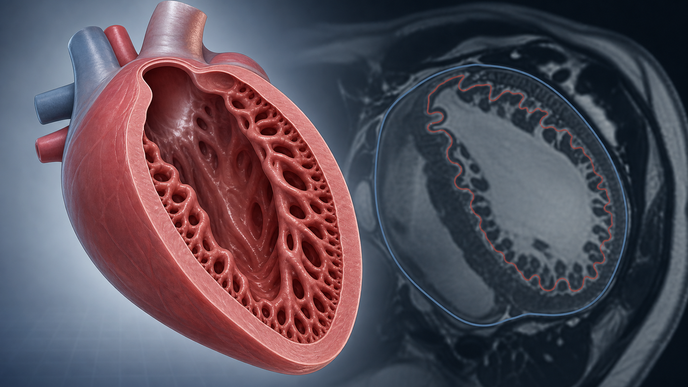
Among 1,160 consecutive patients with nonischemic DCM evaluated by CMR between 2003 and 2023, investigators in conducted an international, multicenter, retrospective, observational, longitudinal study on LV hypertrabeculation and prognosis in DCM. Genetic testing was available in 997 patients (86%), and both CMR and genetic results were independently assessed by investigators blinded to hypertrabeculation status. Hypertrabeculation was defined primarily as an apical maximum fractal dimension of 1.30 or higher and secondarily as a Petersen noncompacted-to-compacted ratio greater than 2.3 at end-diastole. Embolic events were the prespecified primary end point, with advanced heart failure (AHF) and major ventricular arrhythmias (MVA) as secondary end points.
Over a median follow-up of 5.1 years, embolic events occurred in 37 patients (3.2%), advanced heart failure in 62 (5.3%), and MVAs in 136 (11.7%). Hypertrabeculation was not independently associated with embolic events overall, with a hazard ratio 1.50 (p=0.249). Among 496 patients in sinus rhythm, not anticoagulated, and with left ventricular ejection fraction (LVEF) 40% or lower, 14 (2.8%) had embolic events, and hypertrabeculation was not significantly associated with embolic risk (HR, 1.89; 95% CI, 0.66–5.46). Atrial fibrillation (AF) or atrial flutter and lower LVEF, rather than hypertrabeculation, carried the embolic-risk signal in adjusted models.
Apparent lower unadjusted event rates with hypertrabeculation did not persist after covariate adjustment, with adjusted hazard ratios of 0.93 (95% CI, 0.59–1.48) for MVA and 0.82 (95% CI, 0.43–1.57) for AHF. Patients with hypertrabeculation were generally younger and had a milder structural profile, including higher LVEF and lower prevalence of late gadolinium enhancement (LGE) and AF. Prevalence was highest in motor sarcomeric genes and TTN and lowest in nuclear envelope and cytoskeletal/Z-disk groups, but hypertrabeculation did not identify higher embolic, arrhythmic, or heart failure risk within genotype strata.
Within this cohort, hypertrabeculation appeared to track more as a genotype-associated phenotypic trait than as an independently adverse prognostic marker. The authors concluded that left ventricular hypertrabeculation was common in DCM but did not independently predict embolic events, MVA, or AHF in this cohort. They also concluded that the low observed embolic event rate did not support prophylactic anticoagulation based on hypertrabeculation alone, including among patients in sinus rhythm with reduced LVEF.
Clinician Questions
Which patients were included in the subgroup analysis of embolic risk with reduced LVEF and sinus rhythm?The subgroup was limited to patients with DCM who were in sinus rhythm, were not receiving anticoagulation, and had LVEF of 40% or lower. In that clinically relevant subgroup, hypertrabeculation still did not show a significant association with embolic risk.
Which genetic groups showed the highest and lowest prevalence of LV hypertrabeculation in dilated cardiomyopathy?
Hypertrabeculation was most prevalent in motor sarcomeric gene groups and TTN-associated dilated cardiomyopathy and least prevalent in nuclear envelope and cytoskeletal/Z-disk groups. At the gene level, MYH7 and MYBPC3 were among the higher-prevalence examples, whereas LMNA and FLNC were among the lower-prevalence examples. Separately, in broader genotype-group analyses, hypertrabeculation was not associated with higher embolic, arrhythmic, or AHF risk.