
LIFR-Related Disease Beyond Infancy: Neurologic and Immune Findings
Key Takeaways
- In an international cohort of individuals with LIFR-related disease, skeletal findings were present throughout, and survival beyond infancy was documented.
- Neurodevelopmental disorders and primary immunodeficiency were each reported in 73% of the newly described cohort.
- The results report MIS-C in P13 and a COVID-19-associated death in P1, although the discussion also describes P1’s fatal illness as COVID-19–associated MIS-C; the number of MIS-C cases is unclear.
- The p.Cys270Gly variant showed diminished cell-surface presentation and LIF-stimulated signaling in cellular assays.
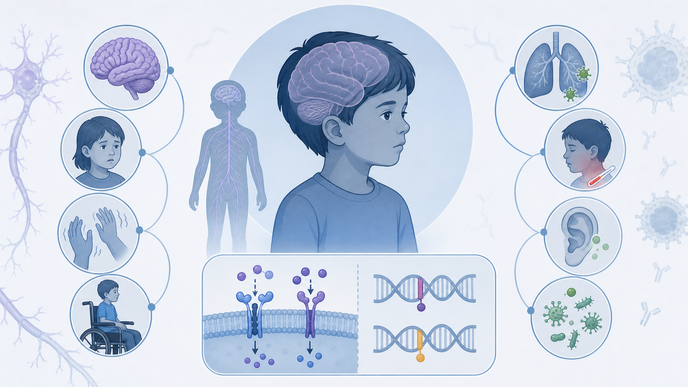
Schmidt and colleagues assembled 22 previously unreported individuals from 20 families with LIFR-related disease in an international series described in their Frontiers in Immunology study of LIFR disease. Molecular testing was not performed in one fetal case, although both parents carried the reported variant. Their combined genotype–phenotype analysis encompassed 74 people, including the newly described individuals and previously published cases they identified. Cellular assays used wild-type LIFR as the comparator for receptor surface presentation, leukemia inhibitory factor (LIF)-stimulated proliferation, and signal transducer and activator of transcription 3 (STAT3) and extracellular signal-regulated kinase (ERK) signaling. Proteomic profiling compared bronchoalveolar lavage cells from one person with p.Cys270Gly with cells from one healthy age- and sex-matched control.
At last report, 15 individuals were alive and 7 had died; reported ages spanned fetal demise at 28 weeks’ gestation to 20 years. All 22 newly described individuals had skeletal findings, including bowed long bones and camptodactyly. Neurodevelopmental disorders and primary immunodeficiency were also recorded, along with recurrent lower respiratory tract infections and atopic disease.
Patient P13 developed coronavirus disease 2019 (COVID-19)-associated multisystem inflammatory syndrome in children (MIS-C) at 20 months, with acute cardiorespiratory failure, acute kidney injury, and coagulopathy. Separately, patient P1 died at 6 years 8 months following COVID-19-associated acute cardiorespiratory failure; the discussion also describes P1’s fatal illness as COVID-19–associated MIS-C, leaving the number of MIS-C cases unclear. In cellular assays, p.Cys270Gly showed reduced surface LIFR, diminished LIF-stimulated proliferation, and reduced STAT3 and ERK phosphorylation. Its proliferation half-maximal effective concentration (EC50) was 639 pg/mL versus 51 pg/mL for wild-type LIFR. Tested extracellular missense variants generally retained some function, whereas a tested cytoplasmic-region variant and a truncated cytoplasmic construct showed near-absent activity. Bronchoalveolar cells from the p.Cys270Gly carrier showed altered vesicular and endolysosomal trafficking-associated proteins relative to the single matched control.
The authors described a tentative association between genotype and survival but noted variable survival even among people carrying the same variant; variant domain alone could not reliably predict survival. Limited allelic diversity, a recurrent founder variant, parental consanguinity, and a predominance of individuals identified as Arabic constrain how widely the cohort’s clinical frequencies can be applied. These international observations are not established rates for the U.S. population. The two COVID-19-associated events cannot establish MIS-C incidence or causation, and cellular assays and one-person proteomic observations do not validate a prognostic test or clinical management strategy.
According to the authors, survival beyond infancy in biallelic LIFR disease can coexist with neurologic and immune manifestations. They left inflammatory susceptibility and prognosis based on an individual variant provisional.
Clinician Questions
Which neurodevelopmental disorders were reported in children with LIFR-related Stüve-Wiedemann syndrome?
Among newly described individuals with biallelic LIFR variants and SWS, investigators recorded motor delay, speech delay, and intellectual disability; these manifestations were not necessarily present together in every child.
Were bronchoalveolar cells collected during an infection for the LIFR p.Cys270Gly proteomic comparison?
Neither the individual with LIFR p.Cys270Gly nor the age- and sex-matched healthy comparator had a clinical infection when bronchoalveolar lavage cells were collected for proteomic profiling.
Did the LIFR p.Cys270Gly variant abolish STAT1 activation after LIF stimulation?
Cells expressing LIFR p.Cys270Gly showed no induced STAT1 phosphorylation even at the high LIF concentration tested, whereas STAT3 and ERK responses were reduced rather than universally absent in those cellular assays. This experimental pathway finding does not predict outcomes for individuals with LIFR-related SWS.
This content is intended for healthcare professionals for educational purposes. The article and its image were developed with AI assistance and reviewed by members of the ReachMD team prior to publication. Please refer to the original source linked for the complete and most up-to-date information.