
Levofloxacin Prophylaxis Failure Tied to Resistance and PK/PD
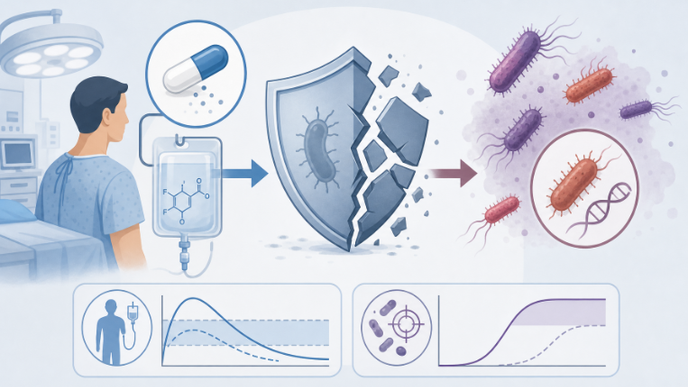
Key Takeaways
- In this prospective matched case–control study, investigators analyzed 60 prophylaxis-failure episodes and 60 matched prophylaxis-success episodes; the design does not establish the overall failure rate during levofloxacin prophylaxis, and profound neutropenia was more common when failure occurred.
- Achievement of the prespecified PK/PD target was uncommon and was independently associated with a lower risk of breakthrough febrile neutropenia.
- Levofloxacin-resistant Gram-negative bacterial colonization was present in 78% of episodes below the prespecified PK/PD target and in 0% of target-attaining episodes.
- An exploratory fAUC0–24/MIC threshold showed high sensitivity but limited specificity and remains a signal rather than an established cutoff.
At Hacettepe University Hospitals, a prospective single-center case-control study of levofloxacin prophylaxis failure evaluated episodes rather than patients. Adults with acute leukemia or allogeneic HSCT received oral levofloxacin 750 mg/day during prolonged neutropenia, and 108 patients contributed 120 neutropenic episodes, split evenly between 60 prophylaxis-success and 60 prophylaxis-failure episodes; 103 episodes had complete pharmacokinetic sampling. Failure meant febrile neutropenia during prophylaxis, whereas success meant remaining neutropenic without fever or antibiotic initiation. Surveillance cultures characterized Gram-negative bacterial (GNB) colonization, plasma was sampled after a scheduled dose, and the prespecified pharmacokinetic/pharmacodynamic (PK/PD) target was a free 24-hour area under the curve to minimum inhibitory concentration ratio (fAUC0–24/MIC) of at least 80.
Profound neutropenia emerged as the clearest host-factor signal and was independently associated with prophylaxis failure, with an odds ratio of 4.17 (95% CI 1.70–10.2; P=0.002). Among microbiologically documented febrile neutropenia episodes, bloodstream infections predominated, Escherichia coli was the most frequent pathogen, and all infecting isolates were levofloxacin resistant. Breakthrough fever therefore tracked with both deeper host immunosuppression and a resistance profile that narrowed the margin for fixed-dose prophylaxis.
Pharmacokinetic/pharmacodynamic target attainment was uncommon: 12/103 (11.7%) achieved fAUC0–24/MIC at least 80, and attainment was independently associated with lower odds of prophylaxis failure, with an odds ratio of 0.12 (95% CI 0.02–0.62; P=0.012). Receiver operating characteristic analysis identified an exploratory fAUC0–24/MIC cutoff of at least 48.46, with sensitivity 86%, specificity 38.3%, and Youden J 0.243. Attainment of that lower threshold was also associated with less prophylaxis failure in adjusted analysis.
The authors noted that interpretation is constrained by the single-center observational design, small subgroups, repeated episodes from some patients, minimum inhibitory concentration assignment based on available colonizing or infecting isolates, oral-only pharmacokinetic data, and the possibility of residual confounding. They interpreted much of the apparent PK/PD failure as minimum inhibitory concentration-driven rather than exposure-driven, noting that maximum concentration, minimum concentration, and area under the curve did not differ significantly between prophylaxis-success and prophylaxis-failure groups. That pattern places the resistance context alongside host severity when explaining why fixed exposure did not reliably translate into effective prophylaxis.
The authors concluded that prophylaxis success in this cohort reflected the interplay of host severity, microbiologic susceptibility, and pharmacologic target attainment. They described the lower receiver operating characteristic-derived threshold as exploratory and in need of external validation.
Clinician Questions
How was levofloxacin prophylaxis failure defined in adults with acute leukemia or allogeneic HSCT?
In adults with acute leukemia or allogeneic HSCT receiving oral levofloxacin prophylaxis, prophylaxis failure meant febrile neutropenia developing during prophylaxis, with febrile neutropenia defined as a tympanic temperature of at least 38.3°C once or at least 38.0°C twice within 1 hour in patients with an absolute neutrophil count below 500/mm3. Prophylaxis success meant remaining neutropenic without fever or antibiotic initiation.
How were MIC values assigned for levofloxacin PK/PD target calculations when no infecting isolate was recovered?
For levofloxacin PK/PD target calculations, investigators used the MIC from a clinical isolate when one was available, used the MIC from colonizing Gram-negative isolates when no clinical isolate was recovered, and used the EUCAST epidemiological cutoff of 2 mg/L for Pseudomonas aeruginosa as a worst-case susceptible scenario when neither clinical nor colonization cultures were positive.
What did the study suggest about why PK/PD target non-attainment tracked with levofloxacin prophylaxis failure?
The study suggested that many apparent PK/PD failures in adults with acute leukemia or allogeneic HSCT were driven by higher MICs in levofloxacin-resistant Gram-negative colonization rather than by lower measured systemic exposure alone. The authors noted that Cmax, Cmin, and AUC did not differ significantly between prophylaxis-success and prophylaxis-failure groups, which supported an MIC-driven interpretation of target non-attainment.
Which organisms caused microbiologically documented febrile neutropenia during levofloxacin prophylaxis in this cohort?
In this cohort, bloodstream infections were more common than urinary tract infections, and Escherichia coli was the most frequent organism, followed by Klebsiella pneumoniae, Enterobacter cloacae complex, and Pseudomonas species. All infecting isolates recovered during febrile neutropenia were levofloxacin resistant.