
Laser Guidance Boosts CT-Guided Puncture Success in Trial
Key Takeaways
- Laser guidance was associated with higher successful lesion access than freehand technique during CT-guided thoracic or abdominal puncture.
- Laser guidance was associated with lower targeting error and fewer confirmatory scans during lesion access.
- Puncture duration was similar, and major complication rates remained low in both groups, with pneumothoraces requiring chest tubes reported in each arm.
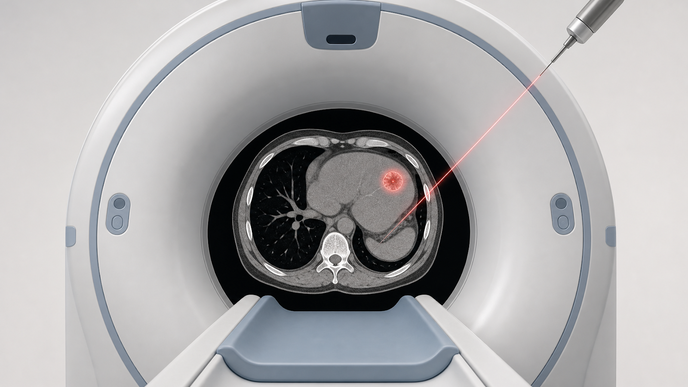
The study randomized 170 adults in a 1:1 ratio to laser-guided intervention or freehand control for thoracic or abdominal lesions measuring at least 10 mm. The primary endpoint was successful lesion access with no more than two needle repositionings. Baseline characteristics were comparable between groups, and the intervention used automatic gantry-mounted laser navigation to project the planned trajectory onto the patient. Secondary endpoints included needle-tip error, CT scan counts, puncture time, and complications recorded during the procedure.
Mean targeting error was 2.1±0.9 mm with laser guidance and 3.5±0.8 mm with freehand technique, with P<.001 for the between-group difference. The primary analysis also showed a significant difference in successful puncture rate at P<.001. Operators needed fewer confirmatory scans, averaging 4.1±2.1 versus 4.9±2.4, with P=.014. Together, these results paired greater targeting precision with fewer verification scans during lesion access.
Puncture duration was similar between groups, averaging 18.3±4.1 minutes with laser guidance and 19.0±5.2 minutes with freehand technique, with P=.45. Major complication rates were low and similar at about 5% in each group, with P=1.00 for the between-group comparison. Those events consisted of pneumothoraces requiring chest tubes in each arm, without an excess in the laser-guided group. The authors characterized gantry-mounted laser guidance as an efficient, low-cost alternative to freehand technique. The reported accuracy gains were not accompanied by a difference in puncture duration.