
KRAS/TP53 Co-Mutation Linked to Better ICI Outcomes in LUAD
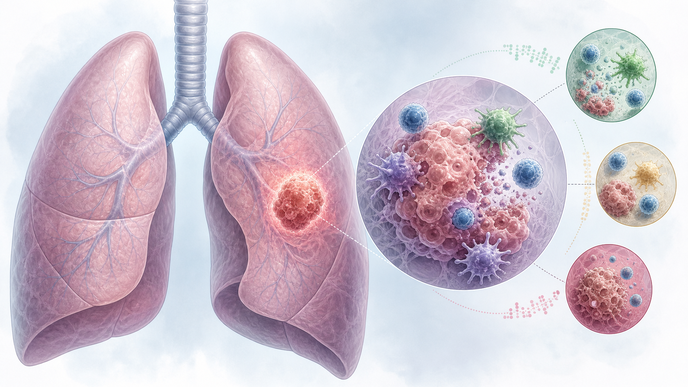
Key Takeaways
- Immunotherapy-treated patients with KRAS-mutant lung adenocarcinoma and concurrent TP53 mutation had significantly longer progression-free survival in two retrospective cohorts.
- Tested mutant p53 variants reduced SPP1 expression; experiments in selected mutant-p53 systems supported repression through FOXA1, opposing mutant KRAS–driven ERK–STAT1-associated SPP1 up-regulation.
- Co-mutant experimental models secreted less SPP1 and supported less monocyte migration, while mouse tumors had fewer M-MDSCs and more CD8-positive T cells.
- Anti-SPP1 plus anti–PD-1 suppressed p53-null KRAS-mutant mouse-tumor growth more than either antibody alone; the combination was not tested in patients.
Investigators retrospectively compared KRAS-only and KRAS/TP53 co-mutant disease in 120 patients with stage III–IV lung adenocarcinoma at Fudan University Shanghai Cancer Center (FUSCC) in Shanghai, diagnosed from July 2019 through August 2024. Patients received a checkpoint inhibitor plus chemotherapy for four cycles every 3 weeks, followed by inhibitor maintenance every 3 weeks until progression or unacceptable toxicity. Investigators evaluated progression-free survival (PFS) and overall survival (OS), including with Cox models. A separate MSKCC cohort included 211 immunotherapy-treated patients whose PFS was compared by mutation status. Engineered human KRAS G12C/p53 R175H or R248Q and mouse KRAS G12D/p53 R172H or R270H systems supported promoter-binding, secretion, migration, rescue, and immunocompetent-mouse experiments. In a p53-null KRAS G12D mouse experiment, six mice per arm received control immunoglobulin G, anti–programmed death-1 (PD-1), anti-SPP1, or both antibodies every 3 days for 2 weeks.
Co-mutant FUSCC patients had significantly longer PFS and OS than KRAS-only patients; the separate MSKCC immunotherapy cohort also showed significantly longer PFS with co-mutation. In tested cellular systems, mutant p53 interacted with FOXA1, whose binding at the SPP1 promoter was linked to reduced SPP1 transcription. Mutant KRAS instead increased SPP1 through extracellular signal–regulated kinase (ERK) and signal transducer and activator of transcription 1 (STAT1)-associated signaling. Tested wild-type p53 manipulations did not change SPP1 protein expression in those settings.
Co-mutant cells secreted less SPP1 and induced less monocyte migration in Transwell coculture; recombinant SPP1 restored migration. Mouse tumors expressing the tested p53 mutants had greater CD8-positive T-cell infiltration and less monocytic myeloid-derived suppressor cell (M-MDSC) infiltration, although untreated tumor volumes did not differ significantly. In p53-null KRAS G12D tumors, combined anti-SPP1 and anti–PD-1 suppressed growth more than either monotherapy, increased granzyme B-positive and interferon-γ–positive CD8 T cells, and reduced M-MDSCs. Mouse body weight did not decline significantly during the short treatment experiment.
Retrospective comparisons among treated patients cannot establish whether TP53 predicts greater benefit from immunotherapy than from a non-immunotherapy regimen or whether the mutation caused the survival differences. Experiments with selected hotspot missense p53 variants leave the effects of other TP53 mutation classes unresolved. The authors identified additional mutant-p53 immune targets and details of the p53–FOXA1 promoter complex as open questions and called for larger prospective cohorts and clinical testing of the antibody combination. Short-term mouse body weight cannot establish patient safety.
The authors associated TP53 co-mutation with favorable outcomes in immunotherapy-treated patients and experimentally linked selected mutant p53 variants to SPP1-related immune remodeling. The antibody-combination result remains confined to mice.
Clinician Questions
How was progression-free survival defined in the FUSCC KRAS-mutant lung adenocarcinoma cohort?
Among FUSCC patients with KRAS-mutant lung adenocarcinoma receiving immunochemotherapy, PFS was measured from treatment initiation until disease progression or death from any cause.
Which patients were eligible for the FUSCC KRAS-mutant lung adenocarcinoma immunochemotherapy cohort?
The FUSCC cohort required histologically confirmed stage III–IV KRAS-mutant lung adenocarcinoma, treatment-naïve status, Eastern Cooperative Oncology Group performance status 0–1, and no targetable EGFR, ALK, or ROS1 alterations.
Do nonmissense TP53 loss-of-function mutations share the SPP1 mechanism in KRAS-mutant lung adenocarcinoma?
In the separate MSKCC immunotherapy-treated KRAS-mutant lung adenocarcinoma cohort, both missense and other loss-of-function TP53 alterations showed favorable clinical associations. The mutant-p53–FOXA1–SPP1 mechanism was tested for selected hotspot missense variants; whether other alterations produce comparable immune remodeling remains unresolved.