
Keratometry Agreement Falls Short for Toric IOL Planning
Key Takeaways
- In routine cataract workup at a single center in Korea, population-level agreement in J0 and J45 was not significantly different across KR-800, IOLMaster 500, and Pentacam HR.
- Average agreement across devices did not translate into reliable interchangeability for an individual eye when toric IOL planning decisions were considered.
- In post hoc exploratory analyses, Pentacam HR classified fewer eyes as toric IOL candidates than the 2 reflection-based devices, although most discordant classifications occurred in borderline eyes with average corneal astigmatism near the 1.0 D cutoff (0.75-1.25 D).
- Among eyes with average corneal astigmatism of at least 1.0 D across the three devices, 21.1% to 33% had inter-device axis differences greater than 10°.
- In post hoc exploratory analyses, predicted residual astigmatism exceeded 0.50 D for at least one device pair in 64.8% of eyes overall.
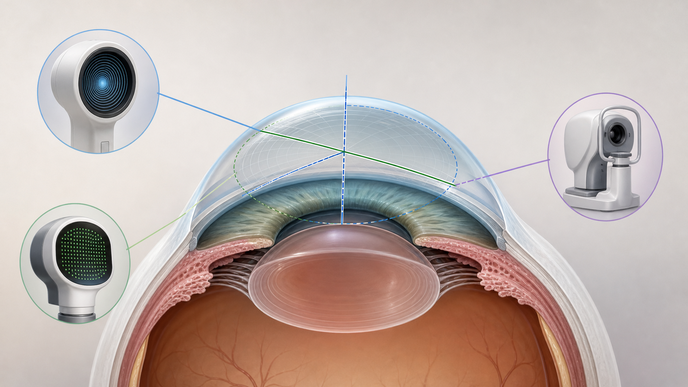
Investigators at Inje University Busan Paik Hospital in Busan, Republic of Korea retrospectively reviewed 227 eyes from 227 cataract surgery candidates with complete same-day measurements from KR-800, IOLMaster 500, and Pentacam HR obtained in a single session, typically within 30 minutes, and analyzed one recorded output per device. In the Lim and Hwang PLOS ONE study of keratometry agreement for toric IOL planning, KR-800 and IOLMaster 500 were reflection-based systems, whereas Pentacam HR contributed simulated keratometry from rotating Scheimpflug imaging, and astigmatism values were converted to the J0 and J45 power-vector components for comparison. For candidacy concordance, each device applied its own cutoff of at least 1.0 D; for the axis-analysis subgroup, the study used eyes with average corneal astigmatism of at least 1.0 D across the three devices, setting up a comparison between population-level agreement and eye-level spread.
Mixed-effects models showed no significant overall device effect for J0 or J45, and intraclass correlation coefficients were 0.894 for J0 and 0.748 for J45. The 95% limits of agreement (LoA) widths ranged from 0.796 to 1.214 D across comparisons, indicating that small average differences still coexisted with broader patient-level spread. On Bland-Altman comparison, KR-800 versus Pentacam HR diverged most, while IOLMaster 500 versus Pentacam HR was relatively closer.
When the analysis shifted to toric relevance, candidacy rates were 53.3% for KR-800, 52% for IOLMaster 500, and 44.5% for Pentacam HR. Classification discordance still occurred and was directionally skewed because Pentacam HR labeled fewer eyes as candidates than the 2 reflection-based devices, but most discordant eyes were borderline cases with average corneal astigmatism between 0.75 and 1.25 D. Axis agreement was also less stable when corneal astigmatism was smaller, making the subgroup at or above the toric candidacy threshold the more clinically relevant comparison.
The retrospective single-center design, routine sequential measurements, and single recorded output per device mean the analysis reflects everyday workflow rather than repeatability under standardized research conditions. The comparison was also limited to anterior corneal keratometry, and Pentacam HR contributed simulated keratometry rather than total corneal power. Predicted residual astigmatism was derived from vector differences, so the study did not directly show whether device variation changed toric IOL selection or postoperative refractive outcomes.
The authors concluded that acceptable population-level agreement among KR-800, IOLMaster 500, and Pentacam HR did not establish interchangeability for individual toric IOL planning under routine clinical conditions. Because the work came from a single Korean center, the findings are best read as workflow-specific agreement data rather than broader North American validation.
Clinician Questions
Which keratometry device pair agreed most closely for toric IOL planning: KR-800, IOLMaster 500, or Pentacam HR?
IOLMaster 500 versus Pentacam HR showed the narrowest Bland-Altman limits for the power-vector components, while KR-800 versus Pentacam HR showed the widest J0 limits and the largest median vector disagreement. This was a relative ranking within the study rather than evidence that any pair was interchangeable for an individual eye.
Why were axis differences larger in eyes with lower corneal astigmatism in this toric IOL planning analysis?
The researchers found an inverse association between astigmatism magnitude and axis disagreement across all device pairs, and they attributed that pattern to shorter astigmatic vectors being more sensitive to measurement noise. They also noted that lower-astigmatism eyes are less central to toric IOL planning than eyes at or above the candidacy threshold, which keeps the toric-candidate subgroup the more clinically relevant comparison.
What part of toric IOL planning was estimated rather than observed directly in this keratometry comparison?
Predicted residual astigmatism was calculated from inter-device vector differences, so it re-expressed measurement disagreement rather than documenting an observed postoperative outcome. The study also did not directly test whether device-related differences changed the toric IOL selected for a cataract surgery candidate or altered postoperative refraction.
Do these keratometry findings apply to posterior corneal astigmatism or total corneal power?
No. The analysis was limited to anterior corneal keratometry, and Pentacam HR contributed simulated keratometry rather than total corneal power, so the findings are framed as agreement data for anterior measurements obtained under routine clinical conditions.