
Ixekizumab–Tirzepatide Linked to Lower Predicted CV Risk
Key Takeaways
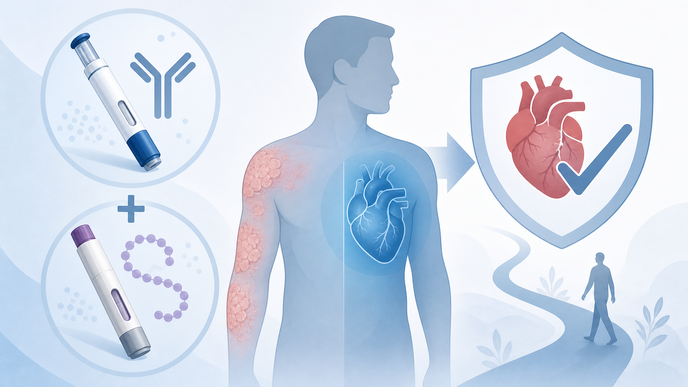
- In US randomized trials involving people with psoriasis or psoriatic arthritis and overweight or obesity, ixekizumab plus tirzepatide was associated with approximately 30% lower Framingham-predicted 10-year cardiovascular disease risk at week 36 than ixekizumab alone, not fewer observed events.
- Systolic blood pressure was lower with combination treatment than with ixekizumab alone in both trials.
- Combination treatment was associated with a greater shift toward lower waist-to-height ratio categories.
Weber and colleagues presented analyses of the TOGETHER-PsO and TOGETHER-PsA trials at American College of Rheumatology (ACR) Convergence 2026. These United States phase 3b, 52-week, multicenter, assessor-blinded, open-label randomized trials enrolled people with moderate-to-severe psoriasis or active psoriatic arthritis and either obesity, defined as body mass index (BMI) ≥30 kg/m², or overweight, defined as BMI ≥27 kg/m² with at least one weight-related comorbidity. Participants were assigned 1:1 to ixekizumab plus tirzepatide or ixekizumab alone under labeling approved by the United States Food and Drug Administration; both groups received individualized diet and exercise counseling. Post hoc longitudinal comparisons examined weight and cardiovascular and metabolic measures at week 36. Framingham equations estimated 10-year cardiovascular disease risk only for participants without pre-existing cardiovascular events; that horizon represents predicted risk, not follow-up.
Across both trials, the combination was associated with broader improvements in cardiometabolic measures than ixekizumab alone. Systolic blood pressure was lower in each trial, and more participants moved toward lower waist-to-height ratio categories; category shifts were tabulated for those with a baseline ratio ≥0.6. Baseline Framingham-predicted scores, ordered as combination treatment versus ixekizumab alone, were 15.38 versus 15.25 in TOGETHER-PsO and 17.46 versus 18.25 in TOGETHER-PsA.
The week-36 predicted hazard ratio (HR) was 0.70 (95% confidence interval [CI] 0.63–0.78) in TOGETHER-PsO and 0.69 (95% CI 0.62–0.78) in TOGETHER-PsA. These modeled comparisons concern calculated 10-year cardiovascular disease risk, not incident cardiovascular events during the trials.
Framingham-modeled risk cannot establish a reduction in cardiovascular events. The longitudinal comparisons were post hoc, and the investigators described any P values as nominal and unadjusted for multiplicity. Although the meeting abstract's transcribed text does not give numerical risk-factor changes or counts for waist-to-height category shifts, the originating report describes mean weight changes of −16.5 kg in TOGETHER-PsO and −18.5 kg in TOGETHER-PsA with combination treatment, versus −1.1 kg in each ixekizumab-alone group. According to the investigators, addressing inflammatory and metabolic pathways together may benefit cardiovascular health; whether the calculated differences translate into fewer clinical events remains unestablished.
Weber and colleagues concluded that ixekizumab plus tirzepatide was associated with more favorable cardiometabolic measures and calculated cardiovascular risk than ixekizumab alone in both psoriatic-disease populations, without demonstrating a difference in cardiovascular events.
Clinician Questions
How were the predicted cardiovascular hazard ratios calculated for ixekizumab plus tirzepatide in psoriasis and psoriatic arthritis?
For TOGETHER-PsO and TOGETHER-PsA comparisons of ixekizumab plus tirzepatide against ixekizumab alone in people with psoriasis or psoriatic arthritis and excess weight, investigators took the ratio of the negative logarithms of the groups' Framingham-predicted survival probabilities, assuming proportional hazards. The calculation used group-level predictions, not observed cardiovascular events.
Which metabolic and inflammatory markers were assessed at week 36 in the ixekizumab–tirzepatide psoriatic-disease trials?
Among TOGETHER-PsO and TOGETHER-PsA participants with psoriasis or psoriatic arthritis and overweight or obesity, investigators assessed weight characteristics, blood pressure, lipids, glucose, glycated hemoglobin (HbA1c), and high-sensitivity C-reactive protein (hsCRP) at week 36. Assessment of these measures does not mean every individual marker improved significantly.