
In-Plane Thyroid FNAB Improved Diagnostic Adequacy
Key Takeaways
- Among thyroid nodules undergoing clinically indicated ultrasound-guided FNAB at three tertiary hospitals in Fujian Province, China, in-plane sampling was associated with higher diagnostic adequacy than out-of-plane sampling.
- Bethesda I nondiagnostic cytology occurred in 1.7% of in-plane thyroid FNAB procedures versus 14.3% of out-of-plane procedures.
- Satisfactory needle-tip visualization was documented in 97.2% of in-plane thyroid FNAB procedures versus 63.6% of out-of-plane procedures, and descriptive analyses linked satisfactory visualization with higher adequacy without establishing it as a mediator.
- Immediate documented hematoma did not differ significantly between approaches, and adjusted and sensitivity analyses remained directionally consistent as preliminary observational evidence rather than proof.
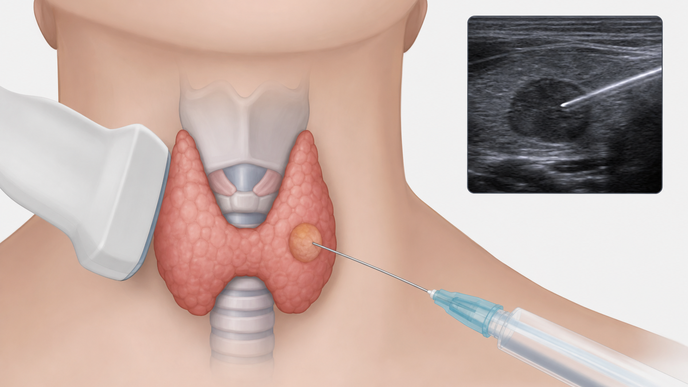
Investigators conducted the Tang et al. multicenter thyroid FNAB trajectory study, a multicenter retrospective cohort of consecutive, clinically indicated ultrasound-guided thyroid fine-needle aspiration biopsy (FNAB) procedures performed between September 2024 and December 2025 at three tertiary hospitals in Fujian Province, China. After screening 650 nodules, the final analyzable cohort included 506 nodules, with one primary cohort center and two external validation centers, and each patient contributed only one index nodule. The exposure was in-plane versus out-of-plane needle approach, and the primary outcome was diagnostic adequacy defined as Bethesda II-VI cytology, with Bethesda I retained as the nondiagnostic outcome; procedures used continuous real-time ultrasound guidance, a standardized 23-gauge 9-cm needle, two documented passes, and no routine rapid on-site evaluation (ROSE), and analyses adjusted for nodule size category, complex anatomical location, operator experience, and center in pooled models, with inverse probability of treatment weighting (IPTW) and Firth-penalized sensitivity analyses.
Across pooled centers, diagnostic adequacy with in-plane versus out-of-plane thyroid FNAB was 98.3% versus 85.7%, and the pooled center-adjusted association remained significant at adjusted OR 12.10 (95% CI 4.28-34.20; P < 0.001). Bethesda I nondiagnostic cytology occurred in 1.7% of in-plane procedures versus 14.3% of out-of-plane procedures. Satisfactory needle-tip visualization was documented in 97.2% versus 63.6%, and descriptive analyses linked better visualization with higher adequacy without testing it as a formal mediator. Immediate documented hematoma did not differ significantly between approaches, and the same directional pattern favoring in-plane sampling persisted in the primary cohort, the external validation centers, and sensitivity analyses despite substantial between-group imbalance in nodule size.
Because the analysis was retrospective and nonrandomized, the observed association remains preliminary and hypothesis-generating rather than causal proof. Confounding by indication is central to interpretation, particularly because smaller nodules were more often sampled with the in-plane approach in routine care. Complete-case exclusions may have introduced selection bias, centralized cytopathology slide review was not performed, and lesion-level features such as fibrosis or calcification were not consistently captured across centers. Safety conclusions extend only to immediate documented hematoma, since pain, vasovagal reactions, delayed adverse events, and patient-reported outcomes were not systematically collected, and the proposed risk-adapted trajectory framework remains a preliminary concept rather than a validated decision algorithm.
In this China-based multicenter cohort, in-plane thyroid FNAB was associated with higher adequacy and more frequent satisfactory needle-tip visualization without a significant increase in immediate documented hematoma. The authors interpreted these findings as support for a preliminary risk-adapted approach to trajectory selection, but prospective validation is still needed before that concept is treated as a formal algorithm.
Clinician Questions
How was diagnostic adequacy defined for thyroid FNAB in this multicenter cohort?
Diagnostic adequacy meant Bethesda II-VI cytology, while Bethesda I was retained in the analysis as the nondiagnostic outcome rather than excluded. That framework also distinguished true nondiagnostic sampling from excluded cases that lacked a retrievable formal cytology report.
Which thyroid nodules were more likely to receive the in-plane approach in this cohort?
Smaller thyroid nodules were more often sampled with the in-plane approach, reflecting real-world trajectory selection based on lesion accessibility, expected needle-tip confirmation, and the safest available access route. The authors highlighted that case-mix imbalance as a reason to emphasize confounding by indication and to use adjusted and sensitivity analyses.
What did the safety analysis actually cover for in-plane versus out-of-plane thyroid FNAB?
The predefined safety endpoint for in-plane versus out-of-plane thyroid FNAB was immediate documented hematoma detected on post-procedural ultrasound or recorded in the procedure note. The cohort did not systematically collect pain scores, vasovagal reactions, delayed adverse events, or patient-reported outcomes, so the safety comparison applies only to immediate hematoma.