
IL-13 Signaling in cDC2 Links Skin Allergy to IgE
Key Takeaways
- In a murine cutaneous allergen sensitization model, skin inflammation was linked to systemic anaphylaxis and positioned as a mechanistic step in the atopic march.
- IL-13 signaling was required in conventional dendritic cells rather than T or B cells for the generation of high-affinity IgE.
- Single-cell transcriptomics localized the IL-13-responsive population to a cDC2 subset with high CX3CR1, Clec10a (CD301a), and CD301b/Mgl2 expression.
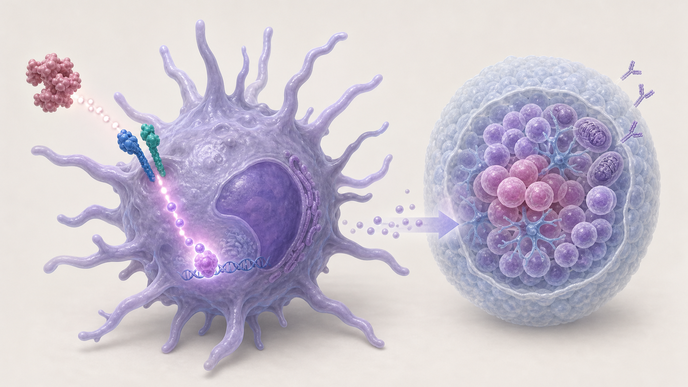
- IL-13 licensing of that cDC2 subset was associated with enhanced antigen presentation, CX3CR1-dependent splenic trafficking, TFH13 differentiation, germinal center activity, and pathogenic high-affinity IgE, which the authors framed as relevant to the atopic march.
Investigators used a murine CAS model linking skin inflammation to systemic anaphylaxis to test how IL-13 shapes allergic immunity after barrier exposure. Cell-specific deletion of the IL-13 receptor alpha-1 subunit, Il13ra1, was used to determine whether T cells, B cells, or conventional dendritic cells (cDCs) were the critical IL-13-responsive compartment for generating high-affinity IgE. Single-cell transcriptomics was then used to define the dendritic-cell subset responding to IL-13, making the cell-specific comparison central to the analysis.
Conventional dendritic cells, not T or B cells, were identified as the essential IL-13 targets for generating high-affinity IgE in IL-13 signaling in cDC2 is required for systemic anaphylactic responses. Single-cell profiling localized that response to a conventional dendritic cell type 2 (cDC2) subset distinguished by high CX3CR1, Clec10a (CD301a), and CD301b/Mgl2 expression. IL-13 licensing was associated with superior antigen-presenting capacity, with upregulation of major histocompatibility complex class II (MHC class II), CD301a, CD301b, and inducible T-cell costimulator ligand (ICOSL). These mature cDC2 then trafficked from the periphery to the spleen through a CX3CR1-dependent mechanism, where they were linked to IL-13-producing T follicular helper 13 (TFH13) differentiation, robust germinal center reactions, and pathogenic high-affinity IgE production.
The authors concluded that IL-13-responsive cDC2 form the central link between cutaneous sensitization and systemic anaphylactic immune responses in this model. In their interpretation, that pathway runs through cDC2 activation, splenic trafficking, TFH13 induction, germinal center amplification, and the generation of pathogenic high-affinity IgE.
Clinician Questions
How did the murine CAS model connect skin inflammation to systemic allergic responses?
It provided a barrier-to-systemic framework in which cutaneous sensitization could be followed into downstream splenic T-cell help and germinal-center immunoglobulin E responses, allowing investigators to map where IL-13-responsive cells acted along that sequence in mice.
Which immune cell compartment emerged as the key IL-13 target for high-affinity IgE generation in cutaneous sensitization?
Cell-specific Il13ra1 deletion pointed to conventional dendritic cells rather than T cells or B cells as the key IL-13-responsive compartment, narrowing the relevant biology to antigen-presenting cells in this murine sensitization pathway.
What features defined the IL-13-responsive cDC2 subset in this allergic sensitization pathway?
The implicated cDC2 population showed high CX3CR1, Clec10a (CD301a), and CD301b/Mgl2 expression, and IL-13 licensing was linked to a more antigen-presenting phenotype marked by MHC class II and ICOSL upregulation.
What does this IL-13-cDC2 finding say about human IL-13-targeted therapy in allergic disease?
The authors presented the IL-13-cDC2 axis as mechanistic rationale for the clinical efficacy of IL-13-targeted therapies in allergic diseases, but the available evidence here is a preclinical murine mechanism rather than a test of human treatment outcomes.