
HNSCC-Derived Extracellular Vesicles Activate Platelets Via Tissue Factor
Key Takeaways
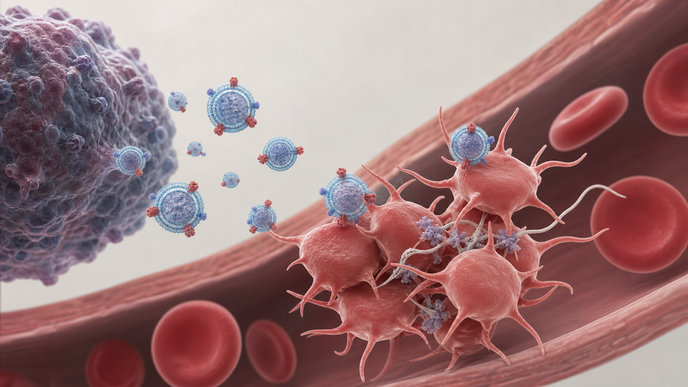
- Tumor-derived vesicles were associated with platelet activation and aggregation, and the experiments also measured chemokine release and ATP release within the response profile.
- The response was described as calcium-dependent, primarily mediated by vesicle-associated tissue factor, and not attributed to signaling through the FcγRIIa-IgG axis.
- Thrombin inhibition and receptor inhibition reduced aggregation, and the authors linked these findings to a prothrombotic environment while also calling for animal validation.
The study used HNSCC-derived extracellular vesicles from the SAS and UD-SCC 5 cell lines, isolated by size exclusion chromatography before platelet experiments and mechanistic testing. Characterization included flow cytometry, electron microscopy, nanoparticle tracking analysis, and Western blotting to define vesicle size, morphology, and marker profile before downstream testing. The background framed tumor vesicle shedding as a route for horizontal transfer of tumor components into platelets within thromboinflammation, linking that process to tumor progression mechanisms. Mechanistic work included inhibitor assays, thrombin activity measurements, and proteomic analyses, using donor blood from individuals without antithrombotic medication exposure during the prior week. Together, these methods established the vesicle preparations and experimental conditions used in the platelet assays.
Platelet activation and aggregation were assessed with aggregometry and flow cytometry, while chemokine release and ATP release were quantified by ELISA. Across these assays, vesicle exposure was associated with platelet activation and aggregation, alongside the biochemical measurements collected in parallel. Researchers also described delayed aggregation kinetics, adding a temporal feature to the functional response pattern. Chemokine and ATP measurements broadened the readout beyond aggregation alone and profiled platelet secretory activity alongside activation markers. This assay set combined functional, activation-related, and secretory platelet responses within one experimental design.
Mechanistic testing did not support platelet activation through the FcγRIIa-IgG axis, narrowing pathway attribution away from an immune complex mechanism. Instead, platelet activation and aggregation were described as calcium-dependent and primarily mediated by vesicle-associated tissue factor. Proteomic analysis confirmed tissue factor within the vesicles, linking the response to coagulation cascade initiation rather than immune complex signaling. Inhibiting thrombin and its receptors reduced platelet aggregation in inhibitor experiments, supporting a role for thrombin in the observed response.
The investigators concluded that these vesicles may help establish a prothrombotic environment through tissue factor-dependent thrombin generation, and they said animal studies are needed to validate and extend the findings.