
Higher Intraoperative Blood Pressure Targets Do Not Improve Outcomes
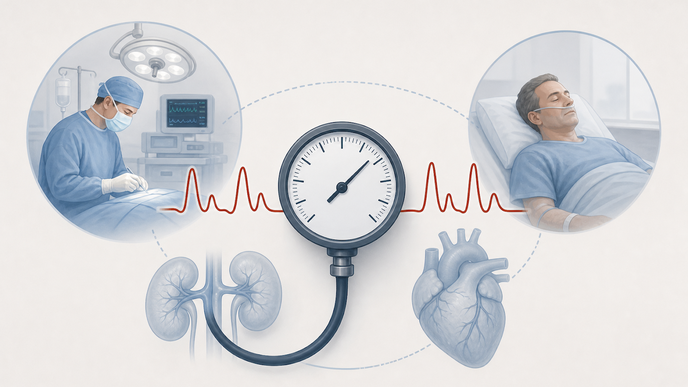
Key Takeaways
- Higher intraoperative blood pressure targets were not associated with broader improvement in major postoperative outcomes during elective noncardiac surgery.
- No reduction was observed for acute kidney injury or acute myocardial injury, and cumulative testing supported those null findings as firm.
- Postoperative delirium was lower with higher targets, but evidence remained insufficient for a firm conclusion, as it did for 30-day major cardiovascular events, stroke, and length of stay.
Investigators conducted a PRISMA-guided search of PubMed, Cochrane CENTRAL, Scopus, and Embase from inception through April 2026. They pooled randomized trials in adults undergoing elective noncardiac surgery with general anesthesia. Higher targets were defined either by fixed absolute thresholds or by values individualized to each patient's preoperative baseline. Routine blood pressure management served as the comparator for mortality, delirium, acute kidney injury, 30-day major cardiovascular events, acute myocardial injury, stroke, length of stay, and intraoperative hypotension. The analysis compared several higher-target strategies with routine intraoperative management in a common adult surgical setting.
For acute kidney injury, higher targets were not associated with reduction versus routine management, with RR 0.95; 95% CI 0.85 to 1.06; p=0.36; I²=16%. Acute myocardial injury also was not reduced, with RR 1.02; 95% CI 0.94 to 1.12; p=0.59; I²=0%. Investigators applied trial sequential analysis and judged the cumulative evidence firm for both outcomes. These were the clearest null findings in the broader postoperative dataset.
Postoperative delirium was lower with higher targets, with RR 0.73; 95% CI 0.54 to 0.98; p=0.04; I²=26%. However, the trial sequential analysis indicated that the cumulative evidence remained insufficient for a firm conclusion on delirium. Higher targets also showed no significant effect on in-hospital or 30-day mortality, with RR 1.00; 95% CI 0.75 to 1.34; p=1.00; I²=0%. Evidence for 30-day major cardiovascular events, stroke, and length of stay likewise remained insufficient, leaving the delirium signal separate from conclusive outcome evidence.
Taken together, the randomized evidence did not show that targeting higher intraoperative blood pressure values improved major postoperative outcomes compared with routine care. The lower delirium estimate remained hypothesis generating rather than confirmed because the cumulative evidence threshold was not met. Overall, the pooled results supported a neutral assessment, with one potential benefit still awaiting confirmation in adequately powered trials.