
HIFU for Abdominal Wall Desmoid Tumors: Response and PFS
Key Takeaways
- Patients with abdominal wall desmoid tumors treated with HIFU at a single center in China had high imaging-defined response and disease control.
- Response appeared higher in initially treated tumors than in tumors treated after postoperative recurrence.
- Long-term progression-free survival was high, although progression or recurrence occurred during follow-up.
- Recorded complications were predominantly low-grade skin reactions, but a femoral nerve injury also occurred.
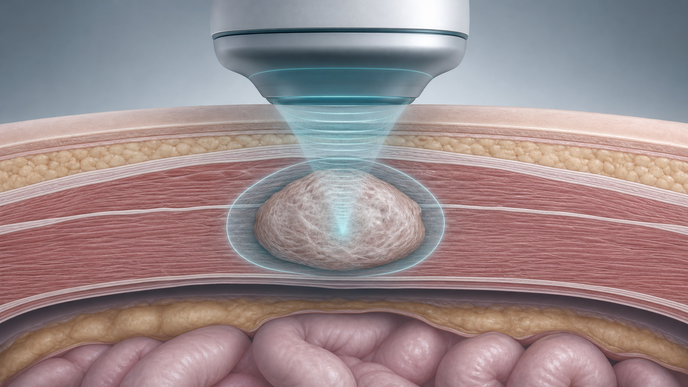
In their retrospective cohort study, Hu and colleagues assessed consecutive eligible patients at the Second Affiliated Hospital of Zhejiang University School of Medicine in China. From July 2015 to May 2023, 55 patients with histologically diagnosed, ultrasound-visible abdominal wall desmoid tumors received HIFU; 46 had initial tumors and nine had postoperative recurrences. Indications included progression, declined surgery or recurrence; 46 patients reportedly declined surgery. Under general anesthesia, clinicians used real-time ultrasound-guided low-power cumulative HIFU, adjusted treatment with contrast-enhanced ultrasound and intermittently cooled the skin. Magnetic resonance imaging (MRI) assessed tumors and guided further sessions at three- to four-week intervals. MRI-based Response Evaluation Criteria in Solid Tumors (RECIST) version 1.1 defined objective response rate (ORR) as complete or partial response and disease control rate (DCR) as response or stable disease. Clinical and imaging follow-up occurred every four to six months; complications were graded using the Common Terminology Criteria for Adverse Events (CTCAE).
Median volumetric ablation was 61% one month after HIFU treatment, following a mean of 3.3 sessions per patient; this measure is distinct from RECIST-defined response. Overall ORR was 82% (45/55), and DCR was 98% (54/55).
ORR was 87% (40/46) for initially treated tumors versus 56% (5/9) after postoperative recurrence, a descriptive contrast by treatment history. After a median follow-up of 58 months (range 15–109 months), Kaplan–Meier estimated five-year progression-free survival (PFS) was 92.7%; median PFS was not reached. Four progression or recurrence events occurred, evenly split between the treatment-history groups.
Investigators recorded five CTCAE grade 1 skin reactions, which resolved with basic skin care, and one grade 2 femoral nerve injury causing localized numbness, which resolved after physical therapy.
This small, retrospective cohort came from one center in China and had no contemporaneous surveillance, surgery or alternative-treatment comparison. The treatment-history contrast was neither adjusted nor tested in the investigators' account, so it does not establish a causal difference or comparative superiority. Generalizability beyond this Chinese center is uncertain. The authors called for larger studies and longer follow-up, particularly to characterize later responses.
Hu and colleagues observed substantial imaging-defined control after HIFU in this selected cohort, with mostly low-grade recorded complications alongside a nerve injury. The findings do not establish an advantage over surveillance or resection.
Clinician Questions
Which patients with abdominal wall desmoid tumors were ineligible for HIFU at the Zhejiang center?
For abdominal wall desmoid tumors considered for HIFU at the Zhejiang center, investigators excluded patients unable to receive general anesthesia, those whose lesions could not be adequately visualized by ultrasound, those with extensive scarring or hardened skin along the ultrasound path, and those with skin or soft-tissue rupture accompanied by infection in the tumor region. These were eligibility boundaries for this cohort, not a general treatment rule.
Can abdominal wall desmoid tumors continue shrinking to complete remission after HIFU?
Among patients treated with HIFU for abdominal wall desmoid tumors in the investigators' cohort, some tumors shrank gradually and ultimately reached complete remission. The authors called for longer observation to clarify whether partial responders may subsequently reach complete remission.
This content is intended for healthcare professionals for educational purposes. The article and its image were developed with AI assistance and reviewed by members of the ReachMD team prior to publication. Please refer to the original source linked for the complete and most up-to-date information.