
Hidradenitis Suppurativa Incidence Higher in Crohn’s and PsA
Key Takeaways
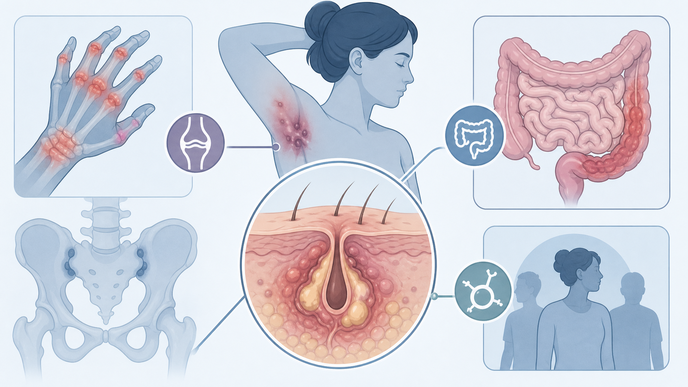
- Among adults with inflammatory joint, skin, eye, and bowel conditions treated largely in North American specialty-center settings, recorded baseline HS was highest in psoriasis (0.65%), followed by PsA (0.52%) and Crohn’s disease (0.47%).
- Crude rates of newly recorded HS were highest in Crohn’s disease and PsA, although new diagnoses were uncommon in absolute terms.
- Compared with separately matched healthcare controls, HS incidence was higher in Crohn’s disease and PsA, increased more modestly in ulcerative colitis, and showed no clear difference in psoriasis or uveitis.
- Matched HS incidence was lower in axial spondyloarthritis and both rheumatoid arthritis cohorts, an observational finding that does not establish protection.
In Zhao and colleagues’ Frontiers in Immunology cohort study, investigators analyzed retrospective electronic health records (EHR) from June 2006 through June 2026, predominantly from secondary and tertiary North American centers. Adults had repeated codes for psoriatic arthritis (PsA), cutaneous-only psoriasis, axial spondyloarthritis, uveitis, Crohn’s disease, ulcerative colitis, seronegative rheumatoid arthritis, or seropositive rheumatoid arthritis. An HS code, L73.2, on or before the index date counted as a baseline diagnosis. Among people without HS recorded before follow-up, a new code after a one-month postindex lag counted as incident HS; follow-up extended through the last recorded encounter. Each disease cohort was compared separately with general-medical-examination healthcare controls without relevant inflammatory disease codes. The investigators used 1:1 propensity-score matching for age, sex, ethnicity, body mass index, metabolic conditions, and recorded smoking-related factors. Incidence rate ratios (IRRs) were the primary matched estimates because proportional hazards assumptions failed in several comparisons.
Recorded baseline HS was most frequent in psoriasis, followed by PsA and Crohn’s disease, but the ordering changed for newly recorded diagnoses. Crohn’s disease had the highest crude rate, at 187.4 per 100,000 person-years, followed by PsA at 134.1 per 100,000 person-years. Psoriasis ranked next; across the cohorts, newly recorded HS remained uncommon in absolute terms. These crude disease-cohort rates are distinct from comparisons with matched healthcare controls.
Against their respective, separately matched controls, Crohn’s disease had an HS IRR of 2.02 (95% CI 1.85–2.20), PsA an IRR of 1.63 (95% CI 1.41–1.88), and ulcerative colitis an IRR of 1.17 (95% CI 1.04–1.32). Psoriasis and uveitis showed no clear matched difference, whereas axial spondyloarthritis and both rheumatoid arthritis cohorts had lower matched incidence. Sensitivity analyses using a longer pre-index look-back, a more specific HS definition, and a later follow-up start yielded lower crude rates but similar relative estimates.
EHR diagnosis frequency is not population prevalence: diagnostic coding may miss HS or classify inflammatory disease nonspecifically, particularly axial spondyloarthritis. Healthcare contact and specialist exposure could affect detection even with delayed follow-up. Matching left some imbalance in diabetes and smoking-related diagnoses; smoking proxies were incomplete, and disease severity and treatment were not matched. The lower matched incidence in axial spondyloarthritis therefore describes an observational association, not a protective biological effect.
Zhao and colleagues identified the clearest association between newly recorded HS and Crohn’s disease or PsA. Although psoriasis had the most prominent pre-existing recorded HS burden, its matched rate of newly recorded diagnoses was not clearly higher. These associations remain subject to low absolute incidence and the limits of observational EHR ascertainment.
Clinician Questions
How was cutaneous-only psoriasis defined when comparing hidradenitis suppurativa incidence across inflammatory diseases?
In Zhao and colleagues’ hidradenitis suppurativa EHR cohorts, cutaneous-only psoriasis required a psoriasis vulgaris diagnosis code and excluded patients with psoriatic arthritis, rheumatoid arthritis, or axial spondyloarthritis codes. That definition kept the psoriasis cohort distinct from the psoriatic arthritis cohort.
Which abscess diagnoses were excluded in the more specific hidradenitis suppurativa sensitivity definition?
Zhao and colleagues’ more specific recorded hidradenitis suppurativa outcome excluded individuals with a cutaneous abscess diagnosis in the groin, perineum, buttock, or axilla at any point. This outcome-definition sensitivity check does not establish that every remaining diagnosis was confirmed.
Recommended Reading
- For more on recognizing hidradenitis suppurativa: Catching HS Before Scarring Sets In
This content is intended for healthcare professionals for educational purposes. The article and its image were developed with AI assistance and reviewed by members of the ReachMD team prior to publication. Please refer to the original source linked for the complete and most up-to-date information.