
HDM SLIT Tracks IgE Conversion Across Three Assays
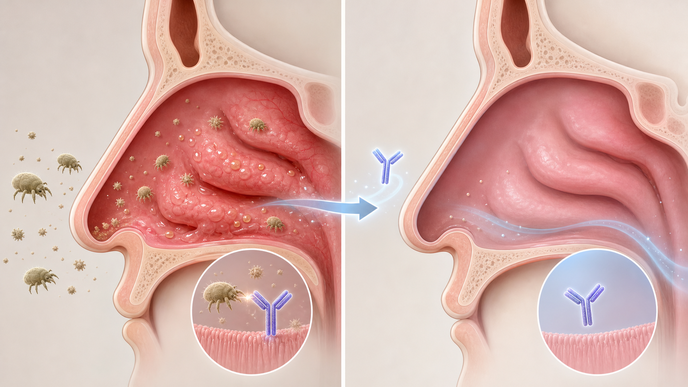
Key Takeaways
- After 12 months of house dust mite sublingual immunotherapy in monosensitized patients with house dust mite-induced allergic rhinitis, qualitative conversion to non-reactive HDM-specific IgE status was reported across all 3 assays, with significance at p < 0.001.
- Post-treatment qualitative conversion to non-reactive HDM-specific IgE status was 94.0% with immunoblot, 83.3% with chemiluminescent immunoassay, and 100.0% with ImmunoCAP.
- Baseline HDM-specific IgE reactivity was 85.7% by immunoblot, 82.1% by chemiluminescent immunoassay, and 92.9% by ImmunoCAP; the paper also reports improved total nasal symptom score, lower total IgE, and differences among assays in how individual patients were classified.
This prospective follow-up identified monosensitized patients using skin prick testing and assessed HDM-specific IgE at baseline and after treatment with immunoblot, chemiluminescent immunoassay (CLIA), and ImmunoCAP as the reference method, alongside total nasal symptom score and total IgE measurement. At baseline, HDM-specific IgE reactivity was detected in 85.7% of patients by immunoblot, 82.1% by CLIA, and 92.9% by ImmunoCAP.
After treatment, researchers reported significant improvement in total nasal symptom score and a reduction in total IgE, while describing overall HDM-specific IgE detection across assays as comparable despite differing agreement when classifying individual patients. The authors further suggest that qualitative specific IgE assessment may offer a clinically meaningful way to monitor immunotherapy response.
Clinician Questions
What HDM-specific IgE conversion rates were reported after 12 months of house dust mite SLIT across immunoblot, CLIA, and ImmunoCAP?
After 12 months of house dust mite sublingual immunotherapy in monosensitized patients with house dust mite-induced allergic rhinitis, qualitative conversion to non-reactive HDM-specific IgE status was reported as 94.0% with immunoblot, 83.3% with CLIA, and 100.0% with ImmunoCAP, with significance across assays at p < 0.001.
What baseline HDM-specific IgE detection rates were reported for immunoblot, CLIA, and ImmunoCAP in monosensitized house dust mite allergic rhinitis?
In monosensitized patients with house dust mite-induced allergic rhinitis, baseline HDM-specific IgE reactivity was reported as 85.7% for immunoblot, 82.1% for CLIA, and 92.9% for ImmunoCAP, which served as the reference method.
Did house dust mite SLIT improve symptoms and total IgE in this 12-month allergic rhinitis study?
The paper reports significant improvement in total nasal symptom score and reduction in total IgE after 12 months of house dust mite sublingual immunotherapy in monosensitized patients with house dust mite-induced allergic rhinitis.