
GPR183–KRAS Signaling and Fluvoxamine in Experimental Uveitis
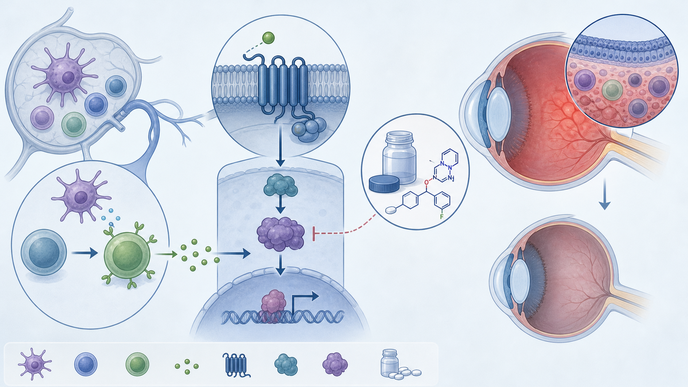
Key Takeaways
- Blood from patients with autoimmune uveitis showed increased CD4+ T-cell GPR183 expression relative to healthy controls.
- GPR183 disruption reduced TH17 inflammatory responses in patient-derived cells and experimental uveitis mice.
- Experimental findings linked GPR183–KRAS signaling to mitochondrial stress and a shift toward glycolysis.
- Fluvoxamine bound GPR183 and reduced inflammation in preclinical models, not in treated uveitis patients.
Investigators in Zhang and colleagues’ GPR183–KRAS study in Science Advances used single-cell ribonucleic acid (RNA) sequencing of peripheral blood mononuclear cells from 5 patients with autoimmune uveitis and 5 healthy controls. Untargeted plasma metabolomics compared 40 patients with 20 controls; separate flow cytometry assessed G protein–coupled receptor 183 (GPR183) in cluster of differentiation 4–positive (CD4+) T cells from 10 patients and 10 controls. Investigators tested GPR183 knockdown in stimulated patient-derived cells and reciprocal rescue involving Kirsten rat sarcoma viral oncogene homolog (KRAS). They induced experimental autoimmune uveitis with interphotoreceptor retinoid–binding protein in wild-type and GPR183-knockout mice, with or without the classical ligand 7α,25-dihydroxycholesterol. Additional experiments tested selective GPR183 inhibition, KRAS intervention, and mitochondrial copper chelation. Screening of U.S. Food and Drug Administration (FDA)–approved compounds and overlapping libraries, docking, and microscale thermophoresis preceded fluvoxamine experiments.
Patient CD4+ T cells showed elevated GPR183. Knockdown in stimulated patient-derived cells suppressed TH17 differentiation, granulocyte-macrophage colony-stimulating factor production, and migration-associated markers; these were ex vivo findings, not patient treatment responses. In mice, GPR183 knockout blocked ligand-associated disease worsening and reduced retinal CD4+ and TH17 infiltration, while selective GPR183 inhibitor NIBR189 reduced retinal damage and inflammation. Experimental uveitis was assessed on day 14 after immunization; selected cell and mouse flow-cytometry comparisons involved n = 5 per group. GPR183 activation suppressed cyclic adenosine monophosphate (cAMP)–dependent protein kinase A (PKA) signaling, altered son-of-sevenless (SOS) phosphorylation and KRAS activation, and was linked to mitochondrial copper accumulation, oxidative stress, impaired respiration, and a shift toward glycolysis. Reciprocal KRAS activation and knockdown experiments and mitochondrial copper chelation changed TH17 and inflammatory readouts in experimental systems.
Fluvoxamine emerged from compound screening and bound GPR183 by microscale thermophoresis (P < 0.001). Separately, fluvoxamine reduced experimental uveitis severity and retinal inflammatory infiltration in mice. Investigators also reported reduced GPR183–KRAS signaling, TH17 responses, and tissue inflammation in laboratory and animal uveitis and colitis models.
Patient blood profiling and experiments with patient-derived cells cannot establish a therapeutic effect in people with autoimmune uveitis. No uveitis patients were reported as treated with fluvoxamine, leaving human efficacy and ocular safety unestablished. Screening FDA-approved compounds offers a U.S.-relevant starting point for drug repurposing, not FDA approval for uveitis; the findings do not establish that the profiled patients represent a U.S. population.
Zhang and colleagues interpreted GPR183–KRAS signaling as a contributor to pathogenic TH17 responses in autoimmune uveitis. They proposed fluvoxamine as a repurposing candidate on the basis of GPR183 binding and anti-inflammatory effects in preclinical experiments.
Clinician Questions
Does GPR183 also drive basal TH17 differentiation in healthy CD4+ T cells?
In healthy-control CD4+ T cells, GPR183 knockdown or exposure to 7α,25-dihydroxycholesterol did not alter TH17 differentiation, migration, or pathogenic readouts. GPR183 manipulation also did not change basal TH17 polarization in naive healthy-control CD4+ cells, qualifying the disease-associated responses observed in autoimmune uveitis.
Can C18-ceramide activate GPR183 in autoimmune uveitis?
Exploratory autoimmune uveitis experiments identified enriched ceramides in patient lipid profiles, and binding assays suggested an interaction between C18-ceramide and GPR183. C18-ceramide–associated TH17 responses and experimental uveitis worsening occurred in wild-type but not GPR183-knockout systems, supporting its possible role as an activating ligand under pathological conditions rather than establishing a human therapeutic target.
Does GPR183 activate KRAS by changing its membrane localization in autoimmune uveitis?
GPR183 activation or knockdown did not change KRAS membrane localization in autoimmune uveitis experiments. Investigators instead linked GPR183 to KRAS activation through cAMP–PKA signaling and SOS phosphorylation, distinguishing signaling activity from membrane positioning without establishing the mechanism in patients.
This content is intended for healthcare professionals for educational purposes. The article and its image were developed with AI assistance and reviewed by members of the ReachMD team prior to publication. Please refer to the original source linked for the complete and most up-to-date information.