
Glomerular Allele-Specific Expression Linked to Kidney Outcomes
Key Takeaways
- In the Nephrotic Syndrome Study Network (NEPTUNE) biopsy cohort of patients with proteinuric kidney disease, glomerular allelic imbalance exceeded tubulointerstitial imbalance.
- Relative imbalance between kidney compartments was greater in proteinuric disease than in control kidneys using a comparable RNA-only analysis.
- Higher relative glomerular imbalance was associated with a lower observed kidney-progression hazard and earlier complete proteinuria remission.
- A mean 86.2% of commonly shared glomerular allele-specific expression genes were classifiable through expression or splicing quantitative trait loci or imprinting.
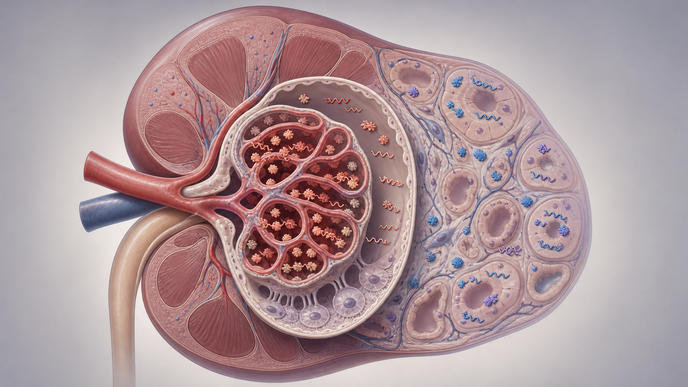
Investigators in the Science Advances study of allele-specific expression in human kidneys analyzed NEPTUNE proteinuric kidney biopsies microdissected into glomerular and tubulointerstitial compartments. Allele-specific expression (ASE) is preferential expression of one gene copy. Bulk ribonucleic acid sequencing (RNA-seq) was paired with whole-genome sequencing (WGS). After quality exclusions, 222 glomerular and 206 paired tubulointerstitial samples remained.
For a separate disease–control comparison, investigators applied a comparable RNA-only ASE pipeline to disease samples and 31 microdissected control kidneys with preserved function and no proteinuric disease. Clinical outcome data were available for 194 NEPTUNE participants. Investigators divided them by high or low glomerular-to-tubulointerstitial ASE proportion ratio (GTAR) to examine a composite kidney-progression endpoint.
In the paired WGS-plus-RNA analysis of NEPTUNE biopsies, median ASE proportion was 11.3% in glomeruli versus 7% in tubulointerstitium (P < 2.2 × 10⁻¹⁶). More ASE genes were identified in glomeruli, and allelic imbalance was predominantly compartment-specific.
In the separate RNA-only disease–control analysis, median GTAR was 1.40 in NEPTUNE kidneys versus 0.97 in controls (P = 2.2 × 10⁻⁶). Among commonly shared glomerular ASE genes, investigators linked imbalance to mapped expression or splicing regulatory loci or to imprinting.
High versus low WGS-plus-RNA GTAR was associated with a lower adjusted hazard of end-stage kidney disease or at least 40% decline in estimated glomerular filtration rate (eGFR; hazard ratio
= 0.35, P = 9.63 × 10⁻⁴). Complete proteinuria remission occurred sooner in the high-ratio group. Glomerular expression differed between groups, with ribosome- and mitochondrial/adenosine triphosphate (ATP)-related pathways up-regulated in the high-ratio group; investigators found no significant tubulointerstitial expression difference.
The outcome association was observational, and the RNA-only method can miss true or near-monoallelic events. Disease and control groups differed in read depth, ancestry, age, and covered genes, prompting use of a normalized compartment ratio. Some participants with paired tissue data lacked outcome data, and kidney failure alone was infrequent, so the principal outcome was a composite. Investigators proposed that ribosome- and ATP-related glomerular expression may mark an adaptive response, not an established protective mechanism.
Clinician Questions
Was glomerular allele-specific expression alone associated with kidney progression in NEPTUNE proteinuric disease?
Stratification by glomerular ASE proportion alone or tubulointerstitial ASE proportion alone showed no significant kidney-outcome association. The observed association concerned the ratio between compartments, not either proportion in isolation.
Which candidate imprinted genes were identified in glomeruli and tubulointerstitium in proteinuric kidney disease?
IGLV6-57 was identified as a previously unrecognized candidate imprinted gene in glomeruli, and GLYATL2 as a candidate in tubulointerstitium. Neither was established as a proven newly imprinted gene or a causal kidney-disease gene.
Did differences in podocyte abundance explain high glomerular ASE ratios in NEPTUNE kidney biopsies?
Computational deconvolution of glomerular RNA-seq found no significant difference in estimated cell-type proportions, including podocytes, between high- and low-GTAR groups. Comparisons within focal segmental glomerulosclerosis, minimal change disease, and membranous nephropathy also found no significant composition differences; these checks do not establish an adaptive mechanism.