
Global Health Workforce Reached 122.1 Million in 2023
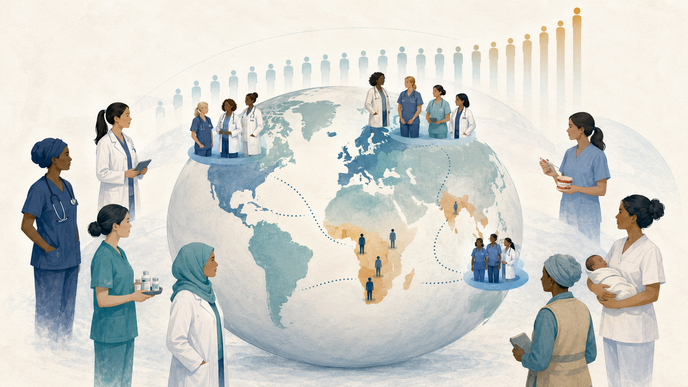
Key Takeaways
- Across 204 countries and territories, the analysis reported growth in the global health workforce from 40.9 million in 1990 to 122.1 million in 2023.
- Women accounted for 71.4% of workforce growth and represented 68.9% of all health workers in 2023.
- Women were most heavily represented among midwives, community health workers, and nurses, while making up less than half of doctors.
- An additional 34.4 million doctors, nurses, midwives, dentists, and pharmacists were estimated to be needed for moderate UHC, with the deepest shortages identified in South Asia and sub-Saharan Africa.
In The Lancet Public Health analysis of health workforce composition and UHC gaps, investigators conducted a systematic analysis for the Global Burden of Disease (GBD) Study 2023 and generated sex-disaggregated estimates for 20 health worker cadres across 204 countries and territories from 1990 to 2023, including the first global estimates of community health workers. Workforce-gap calculations were tied to moderate universal health coverage (UHC), defined as a score of 80 out of 100 on the GBD UHC effective coverage index. The approach linked workforce supply to a common coverage benchmark rather than to headcount alone.
Across that period, the workforce expanded substantially, with nurses remaining the largest cadre in 2023, followed by doctors and community health workers, while pharmacists and dental workers also accounted for sizable shares. Women accounted for 80.7% of nurses, 96% of midwives, and 89.5% of community health workers, while making up less than half of doctors. The authors interpreted that pattern as evidence that women remained concentrated in roles that tend to carry lower pay and fewer leadership opportunities.
When investigators translated staffing levels into the workforce-gap estimates for moderate universal health coverage, the largest profession-specific shortfalls were 23.9 million nurses and midwives and 7.1 million doctors. South Asia carried the largest absolute gaps, and sub-Saharan Africa was another severe shortage setting because workforce density remained especially low relative to high-income countries.
Globally, long-term workforce expansion coexisted with a female-majority workforce and persistent shortfalls against the planning threshold used for moderate UHC. South Asia and sub-Saharan Africa were the most severe shortage settings highlighted in the analysis. The overall picture was one of growth alongside continuing imbalance across professions and regions.
Clinician Questions
What did moderate universal health coverage mean in this global workforce analysis?
Investigators defined moderate universal health coverage as a score of 80 out of 100 on the GBD universal health coverage effective coverage index.
The threshold was associated with minimum workforce densities of 23.8 doctors and 64.5 nurses and midwives per 10,000 people.
It also corresponded to minimum densities of 5.2 dentists and 5.6 pharmacists per 10,000 people.
Did the 34.4 million workforce gap cover all 20 health worker cadres?
No. The sex-disaggregated workforce estimates covered 20 health worker cadres across 204 countries and territories, including community health workers, but the global shortfall estimate was calculated only for doctors, nurses, midwives, dentists, and pharmacists.
Why were community health workers a notable part of the GBD 2023 workforce estimates?
Community health workers were notable because investigators described these as the first global estimates of that cadre within the broader sex-disaggregated accounting of the health workforce, expanding the scope beyond more traditionally counted licensed professions. The analysis also placed community health workers among the most heavily female-represented cadres.