
Fractional CO₂ Combination for Phototherapy-Plateau Vitiligo
Key Takeaways
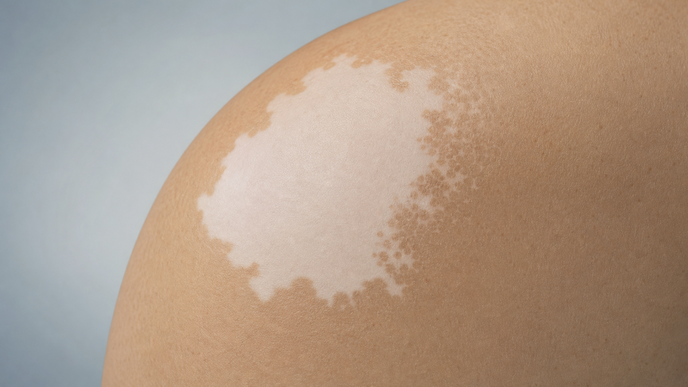
- Among refractory nonsegmental vitiligo lesions that had plateaued during phototherapy, a fractional carbon dioxide (CO₂) laser combination was associated with more reported successful lesions than an active regimen without the laser.
- Acral vitiligo lesions showed much less separation in reported success between the laser-containing and active-control regimens.
- Ex-vivo tissue testing found more widespread, consistent halometasone distribution under the selected laser setting, a finding distinct from clinical repigmentation.
Investigators tested topical formulations and laser settings on 64 fresh human foreskin specimens before assessing fractional CO₂ laser–assisted vitiligo therapy clinically. For halometasone cream, they selected a setting of 15 millijoules (mJ) pulse energy and 10% coverage. These tissue tests evaluated topical delivery, not clinical response in vitiligo lesions.
The randomized clinical comparison involved 98 individuals with 158 refractory nonsegmental vitiligo lesions in separate acral and phototherapy-plateau groups. The laser-containing regimen paired fractional CO₂ laser with plastic-wrapped halometasone cream and 308-nanometer (nm) excimer-lamp treatment. Active control consisted of the same excimer-lamp treatment, a topical calcineurin inhibitor, and halometasone cream, without fractional CO₂ laser. Excimer-lamp treatment occurred twice weekly for three months. Reported success proportions describe lesions rather than the proportion of individuals who responded, because patients could contribute multiple lesions.
After three months, 50% of phototherapy-plateau lesions receiving the laser-containing regimen were reported as successful, versus 10% with active control. The separate acral comparison showed considerably less separation: success was reported for 8% of lesions with the laser-containing regimen versus 6% with active control. In ex-vivo tissue, halometasone distribution was more widespread and consistent under the selected laser setting.
The clinical observation ended after three months, so the difference among phototherapy-plateau lesions does not establish how long a response might last. It also does not demonstrate a shorter overall treatment course or show that future phototherapy plateaus can be prevented. The acral comparison involved a distinct lesion group, not a direct test of how an acral lesion would respond after a phototherapy plateau. Improved distribution in excised tissue cannot establish patient repigmentation or clinical safety.
The investigators reported greater lesion-level success with the laser-containing combination among phototherapy-plateau lesions than with the active regimen without laser, but no comparably clear benefit among acral lesions.
Clinician Questions
How many people and lesions were in the acral versus phototherapy-plateau vitiligo groups?
The comparison included 46 people with 98 acral lesions and 52 people with 60 phototherapy-plateau lesions. These are lesion-category totals, not numbers assigned to the laser or active-control arms.
Were clinical adverse events quantified for fractional CO₂ laser plus halometasone in refractory vitiligo?
Ex-vivo testing of fractional CO₂ laser with halometasone cream on fresh human foreskin was described as having minimal side effects, but detailed clinical adverse-event counts were not available for patients with refractory nonsegmental vitiligo. Tissue findings do not establish patient-level safety or long-term tolerability.