
Four-Year RHONE-X Data Show Durable Faricimab Outcomes in DME
Key Takeaways
- Visual acuity gains of about 10 to 11 letters were maintained, alongside sustained CST reductions and DME absence by study definition (CST < 325 μm) in more than 90% of patients at study end.
- About 80% of patients reached intervals of at least every 12 weeks, with median injection counts of 7 to 8 over 2 years.
- Adverse event discontinuation and intraocular inflammation were uncommon, and the investigators said the safety profile remained consistent with earlier YOSEMITE and RHINE findings.
The RHONE-X extension study was a global phase 3, multicenter, nonrandomized, 2-year open-label extension of YOSEMITE and RHINE in diabetic macular edema. Primary end points were long-term safety and tolerability, and efficacy outcomes were exploratory within the extension design. Among 1622 parent-study completers, 1474 entered RHONE-X and 1204 completed the extension over two additional years. Patients transitioned without monthly initiation doses to BCVA- and CST-guided faricimab treat-and-extend dosing, with monthly visits during four masked months and intervals up to 16 weeks thereafter. The extension tracked durability over time rather than testing a new comparison.
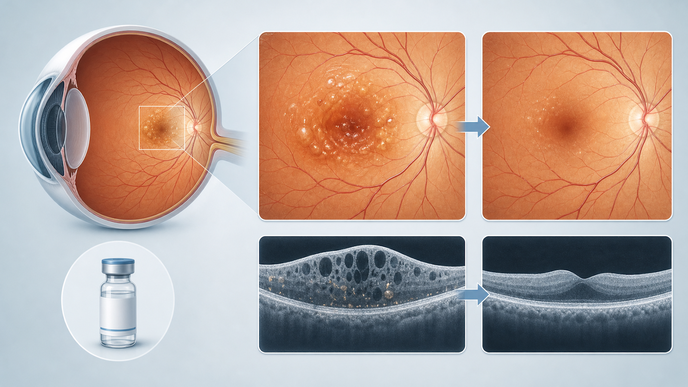
Across prior treatment-history groups, adjusted mean BCVA changes from baseline to the end of RHONE-X were +10.1, +11.4, and +9.5 letters. The groups reflected prior faricimab treat-and-extend, prior faricimab every-8-week, and prior aflibercept every-8-week treatment histories in the parent studies. Corresponding CST reductions were −198.3, −202.5, and −204.9 micrometers. More than 90% of patients had absence of DME (CST < 325 μm) at completion, regardless of earlier treatment assignment. Visual and anatomic control were maintained across the treatment-history groups through long-term follow-up.
Treatment intensity remained limited over the two-year extension, with median injection counts of 7, 8, and 8 across the groups. Those totals accrued over two additional years of follow-up. By completion, approximately 80% of participants were receiving faricimab at intervals of at least every 12 weeks. Interval adjustments followed BCVA and CST criteria, and the regimen allowed extension to as long as 16 weeks when appropriate. Extended dosing intervals remained common through RHONE-X follow-up.
Safety and tolerability were the primary extension end points. Adverse events leading to treatment discontinuation occurred in 1.5% of patients, and intraocular inflammation occurred in 1.3%. The investigators described faricimab as well tolerated, with a safety profile consistent with YOSEMITE and RHINE. Analysis windows for study years 1, 1.5, and 2 were defined to accommodate visit asynchronicity across the extension. The authors concluded that faricimab provided long-term safety, efficacy, and durability in DME under a treat-and-extend regimen.