
Food Allergy Linked to Higher ARFID-Related Scores in Children
Key Takeaways
- In children aged 2–9 years with physician-diagnosed food allergy, median total NIAS-PR scores were higher than in age- and sex-matched healthy controls at 17 [11–24] versus 12 [7–18] (p < .001).
- The between-group difference was concentrated in picky-eating and fear-related scores (both p < .001), while appetite scores did not differ significantly (p = .311).
- Within pediatric food allergy, fear scores were higher in children with urticaria-type reactions and in those with anaphylaxis, and the NIAS-PR was used as a screening instrument rather than a diagnostic assessment.
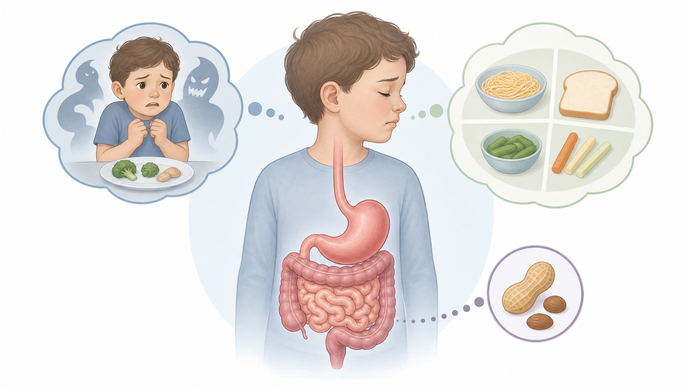
The study was conducted in a pediatric allergy and immunology outpatient setting, with enrollment from September 15, 2025, to February 5, 2026. Food allergy was physician confirmed by oral food challenge and/or a compatible clinical history supported by food-specific IgE and/or skin-prick testing, and the cohort included IgE-mediated disease as well as mixed-type food allergy with atopic dermatitis, while excluding non-IgE-mediated food allergy and eosinophilic gastrointestinal diseases. The 9-item parent-report screening tool measures picky eating, lack of interest or appetite, and fear of aversive consequences, with each subscale scored 0–15 and the total score 0–45. Item-level differences followed the same pattern, with higher scores on Items 1–3 and 7–9 but not on appetite-related items.
Within the food allergy cohort, total NIAS-PR scores were higher in children with asthma than in those without asthma, at 19 [14–39] versus 16 [10–22] (p = .043). The authors also reported higher fear subscale scores in children with urticaria-type reactions (p = .009) and in those with a history of anaphylaxis (p = .014); lower weight-for-age and height-for-age z scores were also seen in the food allergy group, at −0.20 ± 1.10 versus 0.26 ± 1.05 and −0.40 ± 1.18 versus 0.15 ± 1.18, respectively, while BMI z scores did not differ (p = .117). Multiple food allergy was present in 44% of the food allergy cohort. The authors noted that NIAS-PR served as a screening measure, that no formal DSM-5-TR psychiatric diagnosis or validated diagnostic cutoff was established, that psychosocial variables such as child or parental anxiety were not assessed, and that the relatively low fear scores warrant cautious interpretation.
Clinician Questions
How did NIAS-PR total scores compare between children with food allergy and healthy controls?
In 234 children aged 2–9 years, including 117 with physician-diagnosed food allergy and 117 age- and sex-matched healthy controls, the median total NIAS-PR score was 17 [11–24] in the food allergy group versus 12 [7–18] in controls, with p < .001. These were parent-reported ARFID-related eating behavior scores.
Which NIAS-PR domains differed in children with food allergy?
Children with food allergy had higher parent-reported NIAS-PR scores in the picky-eating and fear domains, both with p < .001 versus healthy controls, while appetite scores did not differ significantly (p = .311). Item-level differences were reported for Items 1–3 and 7–9, not for appetite-related items.
What clinical features within pediatric food allergy were associated with higher ARFID-related eating behavior scores?
Among children with food allergy, total NIAS-PR scores were higher in those with asthma than in those without asthma, at 19 [14–39] versus 16 [10–22] (p = .043). Fear subscale scores were also higher in children with urticaria-type reactions (p = .009) and in those with a history of anaphylaxis (p = .014), while other atopic conditions, reaction type, tolerance development, and specific culprit foods were not associated with total scores.