
Faricimab Switch in nAMD: Retinal Gains, Uncertain Visual Benefit
Key Takeaways
- Chinese patients with nAMD and persistent retinal fluid despite monthly aflibercept had significant retinal thinning after switching to faricimab.
- At 12 months, SRF prevalence fell from 82.4% to 50%, and IRF prevalence fell from 52.9% to 23.5%.
- Overall BCVA improvement was not statistically significant in the primary analysis, although a month-12 sensitivity analysis found a significant difference.
- Observed injection intervals lengthened significantly under PRN faricimab care, without establishing pharmacologic durability.
- Decreases in SHRM height tracked contemporaneous interval lengthening, but not subsequent interval changes or concurrent BCVA changes, in an exploratory subgroup.
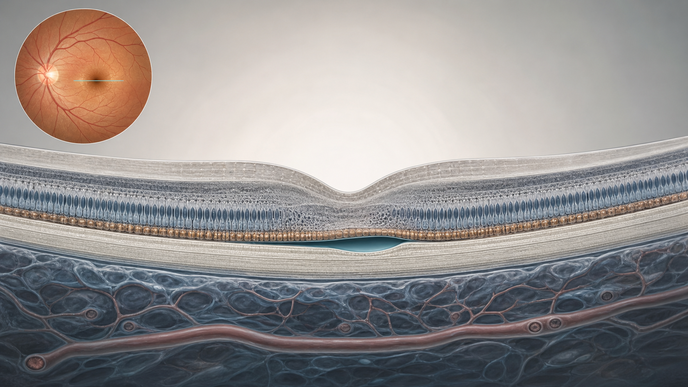
In Wang and colleagues’ faricimab-switch study in Drug Design, Development and Therapy, investigators retrospectively followed 34 patients with 34 eyes at Shandong Provincial Hospital in China for 12 months. Eyes had persistent or recurrent subretinal fluid (SRF) or intraretinal fluid (IRF) on optical coherence tomography (OCT) despite at least three consecutive aflibercept injections four weeks apart; there was no concurrent continuing-aflibercept group. Faricimab began one month after the last aflibercept dose, with one injection followed by pro re nata (PRN) reinjection for progressive disease and assessments every four weeks. Investigators measured best-corrected visual acuity (BCVA), central macular thickness (CMT), pigment epithelial detachment (PED) height, fluid, hemorrhage, and injection intervals; they separately explored associations involving subretinal hyperreflective material (SHRM).
Mean CMT decreased by 55.59 μm at month 12 (adjusted P = 0.0009), with significant thinning at month six after correction for multiple comparisons. PED height was significantly lower at month 12; SRF declined significantly by month six and IRF by month 12. Hemorrhage size decreased significantly in affected eyes. Fluid and hemorrhage nevertheless persisted in some eyes, and fewer than half achieved a dry macula. BCVA improved numerically, but the primary repeated-measures analysis found no significant overall change (P = 0.065).
In contrast to the primary visual finding, a linear mixed-effects sensitivity analysis found significant BCVA improvement at month 12 (adjusted P = 0.002). Under PRN management, the observed eye-level median injection interval increased from 4.5 to 8.0 weeks (P = 0.017).
Among 13 eyes with baseline SHRM, exploratory analysis using generalized estimating equations (GEE) linked increases in SHRM height to contemporaneous shortening of injection intervals: B = −3.299 weeks of interval change per 100-μm increase in height (95% CI −4.323 to −2.275; P < 0.001). Conversely, decreases in height accompanied contemporaneous interval lengthening. Temporally ordered SHRM changes did not significantly predict later intervals, and SHRM changes did not correlate significantly with concurrent BCVA changes.
Without a continuing-aflibercept comparator, this small, single-center retrospective cohort cannot establish comparative switching efficacy or causality. Selection bias, disease fluctuation, and regression to the mean could contribute to the observed changes. PRN intervals also depend on visits, physician decisions, and adherence, rather than measuring drug durability directly. The discordant primary and sensitivity BCVA findings further qualify the visual interpretation. The post hoc SHRM analysis did not adjust for concurrent disease-activity markers and did not demonstrate prediction. Adverse-event outcomes were not provided. Findings from this Chinese cohort do not establish applicability to U.S. populations.
Wang and colleagues associated the faricimab switch with improved retinal anatomy and longer observed injection intervals, while primary overall visual improvement was not statistically established. Complete anatomical clearance was not universal, and comparative efficacy, pharmacologic durability, and prospective SHRM prediction remain uncertain.
Clinician Questions
What prompted reinjection after switching to PRN faricimab for inadequately responsive nAMD?
Under the investigators’ PRN faricimab protocol for nAMD inadequately responsive to aflibercept, progressive disease prompted reinjection: a BCVA decline of at least five ETDRS letters (or 0.1 logMAR), new or worsening SRF or IRF, or increased CMT or PED compared with the prior visit. Stable residual fluid without visual decline or increased CMT or PED could be monitored without reinjection.
Which eyes were excluded from the Chinese nAMD faricimab-switch cohort?
At Shandong Provincial Hospital, the cohort switching from aflibercept to faricimab for nAMD excluded eyes with neovascularization from other causes, including high myopia, trauma, angioid streaks, or central serous chorioretinopathy; confounding macular conditions, including diabetic maculopathy, retinal vein occlusion, or vitreomacular interface disorders; prior vitrectomy or photodynamic therapy; or ungradable follow-up OCT scans.
Recommended Reading
- For more on managing VEGF-refractory retinal fluid: Treating Outside the Box: New Pathways to Retinal Vascular Stability
This content is intended for healthcare professionals for educational purposes. The article and its image were developed with AI assistance and reviewed by members of the ReachMD team prior to publication. Please refer to the original source linked for the complete and most up-to-date information.