
External Validation of Deep Learning for Dysplastic Barrett's Esophagus
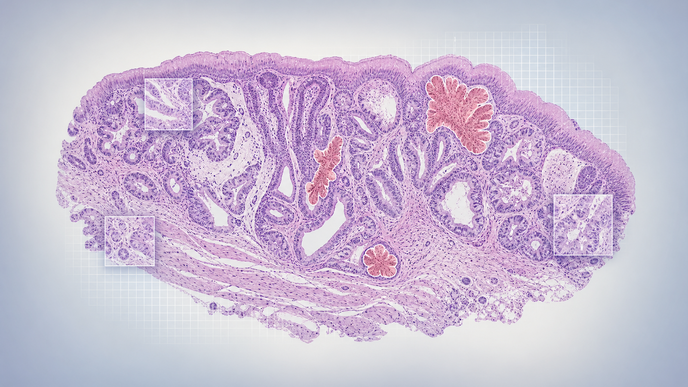
Key Takeaways
- External validation of a previously cross-validated Barrett's esophagus dysplasia model used 489 whole-slide images from three academic centers.
- Sensitivity and specificity varied across nondysplastic Barrett's esophagus, low-grade dysplasia, and high-grade dysplasia.
- The authors concluded the externally validated model showed substantial accuracy for grading Barrett's esophagus dysplasia on whole-slide images.
The validation cohort included 232 slides classified as nondysplastic Barrett's esophagus, 117 as low-grade dysplasia, and 140 as high-grade dysplasia. A consensus interpretation by two expert study pathologists served as the criterion standard for slide labels. Slide stain characteristics were normalized with cycle-generative adversarial networks before an ensemble combined a You Only Look Once model with a ResNet101 classifier. Participants had a mean age of 66.9 years with a standard deviation of 11.4 years, and 413 of 489 were men. Testing was performed on digitized whole-slide images from external academic centers.
Diagnostic performance varied across the three histologic categories on external testing. Sensitivity and specificity were 73.3% and 93.4% for nondysplastic Barrett's esophagus, 84.6% and 80.6% for low-grade dysplasia, and 80.7% and 94.8% for high-grade dysplasia. F1 scores were 0.81 for nondysplastic Barrett's esophagus, 0.69 for low-grade dysplasia, and 0.83 for high-grade dysplasia. The 95% confidence intervals ranged from 67.09% to 78.85% for nondysplastic sensitivity and from 91.97% to 96.91% for high-grade specificity. Specificity was lower for low-grade dysplasia than for the nondysplastic and high-grade categories.
The work was framed against substantial interobserver variability and overcalling of dysplasia during manual community pathologist reads. Investigators concluded that the externally validated model showed substantial accuracy for grading Barrett's esophagus dysplasia on whole-slide images.