
EUS Morphology Type C Predicts Misdeployment in EUS-GE
Key Takeaways
- In 165 consecutive adults with unresectable malignant gastric outlet obstruction treated with EUS-guided gastroenterostomy at 13 tertiary centers in Taiwan, technical success was 98.2% and clinical success was 95.2%, with stent misdeployment in 4.8% (8/165) and an overall adverse event rate of 7.3%.
- Cross-sectional target-bowel visualization on EUS, classified as EM type C, carried the highest observed stent misdeployment risk at 33% and was the only independent predictor on multivariable analysis.
- From 2023 to 2025, no misdeployments were observed in the later 80-patient cohort versus 8 events among the first 85 patients, and stent misdeployment was also independently associated with shorter survival.
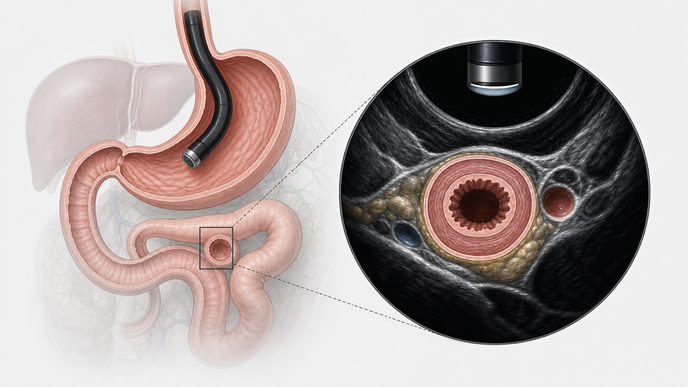
This multicenter observational study was conducted within a prospectively maintained registry with mixed retrospective-prospective morphology assessment, and the primary outcome was intraprocedural stent misdeployment. Fluoroscopic morphology types I through IV described bowel configuration near the ligament of Treitz, while EUS morphology classified the target loop as type A when the bowel was longitudinal and perpendicular to the ultrasound beam, type B when it was longitudinal and parallel to the probe, and type C when it appeared as a cross-sectional circular structure. Interobserver agreement was high for both systems, with κ=0.874 for fluoroscopic morphology and κ=0.902 for EUS morphology. FM type II was more frequent in patients with misdeployment than in those without (25.0% vs 3.8%; p=0.030), and no misdeployments were observed with EM type A.
Eight misdeployments occurred, and all were managed with over-the-scope clip closure, with same-session salvage of gastric outlet obstruction achieved in 87.5% (7/8) of cases. All misdeployments were type I or type II, and no procedure-related mortalities were reported. After the 2023 stepwise approach prioritized EM type A or B, avoided EM type C, and minimized stomach-bowel distance, the later 80-patient cohort had 0 misdeployments versus 8 events among the first 85 patients (p=0.006). The later cohort also had shorter procedure time and lower saline volume.
Patients with stent misdeployment had shorter median survival than those without it, and misdeployment remained independently associated with diminished survival on multivariable analysis (aHR 2.57; 95% CI 1.22-5.41; p=0.013). Pancreatic cancer, malnutrition, poor performance status, ascites, and distant metastasis were also independently associated with worse survival in the model. The authors presented the morphology framework as a safety-oriented way to identify higher-risk anatomy, while noting the observational design, mixed retrospective-prospective classification of earlier cases, the small number of misdeployment events, possible learning-curve and temporal confounding, and experience limited to the WEST technique.
Clinician Questions
What EUS morphology pattern carried the highest stent misdeployment risk during EUS-guided gastroenterostomy for malignant gastric outlet obstruction?
During EUS-guided gastroenterostomy for malignant gastric outlet obstruction, EM type C, defined as cross-sectional circular visualization of the target bowel loop, carried the highest observed stent misdeployment risk at 33% and was the only independent predictor on multivariable analysis, with aOR 16.87 (95% CI 3.17-89.71; p=0.001).
How often did stent misdeployment occur during EUS-guided gastroenterostomy, and how was it managed in this malignant gastric outlet obstruction cohort?
In this malignant gastric outlet obstruction cohort undergoing EUS-guided gastroenterostomy, stent misdeployment occurred in 8 of 165 patients (4.8%); all cases were managed with over-the-scope clip closure, and same-session salvage for gastric outlet obstruction was achieved in 7 of 8 cases (87.5%). All misdeployments were type I or type II, and no procedure-related mortalities were reported.
What changed after the 2023 morphology-based stepwise strategy in EUS-guided gastroenterostomy for malignant gastric outlet obstruction?
After the 2023 morphology-based stepwise strategy prioritized EM type A/B, avoided EM type C, and minimized stomach-bowel distance in EUS-guided gastroenterostomy for malignant gastric outlet obstruction, the later 80-patient cohort had zero misdeployments compared with 8 events among the first 85 patients (p=0.006). The authors also noted possible learning-curve and temporal confounding in that comparison.