
EQA Data Show Better Kidney Biomarker Precision Over 15 Years
Key Takeaways
- A large Brazilian External Quality Assessment (EQA) program tracked serum creatinine, urinary creatinine, urinary albumin, and total urinary protein over 15 years and showed improving precision and adequacy.
- Amidinohydrolase/oxidase methods appeared to perform best analytically for both serum and urinary creatinine.
- Turbidimetric urinary albumin methods and benzethonium chloride total urinary protein methods showed the strongest analytical performance among the non-creatinine assays.
- Jaffé-based creatinine methods remained the most commonly used, even though more specific alternatives generally performed better analytically.
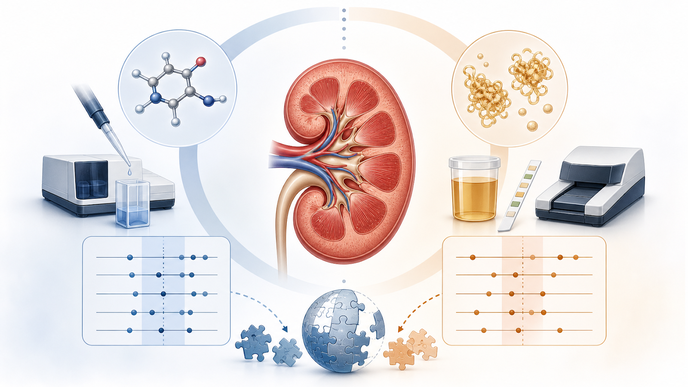
Investigators examined a retrospective External Quality Assessment analysis of kidney biomarkers from a Brazilian proficiency testing provider accredited to ABNT-NBR-ISO/IEC 17043:2011, spanning January 2009 through March 2024. The review covered serum creatinine, urinary creatinine, urinary albumin, and total urinary protein, and the serum creatinine program included 4,927 laboratories and 303,983 datasets. Materials were distributed in four rounds per year as fresh-frozen, lyophilized, minimally manipulated serum and urine controls. Analytical performance was assessed with coefficient of variation (CV) and adequacy percentage (%Adequacy), with Kruskal-Wallis used for method comparisons and Mann-Kendall for time trends. Maximum Permissible Dispersion (MPD) from the most recent assay round was used to exclude excessively dispersed results from boxplot displays.
Within the 15-year kidney biomarker laboratory performance dataset, amidinohydrolase/oxidase and enzymatic serum creatinine methods had the best median CVs, at about 3.3% and 3.4%, respectively, and amidinohydrolase/oxidase also performed best for urinary creatinine at about 4.5% CV. Jaffé-based methods remained the most frequently reported for creatinine testing in both serum and urine, and serum creatinine CVs tended to be lower at concentrations above 2 mg/dL.
Turbidimetric urinary albumin and benzethonium chloride total urinary protein methods each had median CVs of about 5%. Across all four biomarkers, between-method CV differences and time trends in CV and %Adequacy were significant at p < 0.0001. Turbidimetric methods predominated in the urinary albumin program, while pyrogallol red-based methods were most commonly used in the total urinary protein program.
The analysis examined analytical performance in proficiency testing materials rather than patient outcomes, and clinical data were not available. Commutability of the fresh-frozen, lyophilized, minimally manipulated serum and urine controls was not formally assessed. The authors identified persistent reliance on Jaffé-based creatinine methods, despite specificity limitations and weaker performance than more specific alternatives, as an ongoing concern for comparability and clinical reliability. Because participating laboratories were drawn largely from Brazil, these findings reflect that testing environment, although fixed decision thresholds for creatinine- and albumin-based kidney assessment depend on equivalent results across laboratories in any setting.
Over 15 years, precision and adequacy improved across serum creatinine, urinary creatinine, urinary albumin, and total urinary protein in this Brazilian EQA program. Amidinohydrolase/oxidase methods for serum and urinary creatinine, turbidimetric urinary albumin methods, and benzethonium chloride total urinary protein methods showed the strongest analytical performance. Continued predominance of Jaffé-based creatinine methods remained the main unresolved standardization concern.
Clinician Questions
What does %Adequacy measure in external quality assessment for kidney biomarkers?
It is the proportion of reported results that fall within acceptable performance limits set by the EQA provider, so it complements CV by showing how often laboratories met the program's acceptability standard across serum creatinine, urinary creatinine, urinary albumin, and total urinary protein testing.
Does improved EQA performance for creatinine, albumin, and urinary protein assays translate to patient outcomes?
No direct patient-outcome conclusion can be drawn from these data because the analysis evaluated proficiency testing materials rather than clinical outcomes, no clinical data were available, and commutability of the fresh-frozen, lyophilized, minimally manipulated serum and urine controls was not formally assessed.
Why does creatinine and albumin assay standardization matter when fixed kidney disease thresholds are used across laboratories?
Fixed decision thresholds assume equivalent measurements across methods, so noncomparable serum creatinine or urinary albumin results can shift chronic kidney disease classification or risk assessment across laboratories without a true biologic change and may contribute to inappropriate clinical management.
How were overly dispersed assay results handled in the kidney biomarker EQA analysis?
Investigators used Maximum Permissible Dispersion from the most recent round of each assay to exclude excessively dispersed results from boxplot displays, treating it as a visualization step rather than a change to the underlying program results.